Showing posts with label Silicon Valley. Show all posts

Monday, 14 September 2026

Artificial Intelligence and Its Effect on Entry-level Hiring

Artificial Intelligence, despite not being fully-formed, is no longer merely threatening to shake up the labor market. By most accounts, it has already happened. Even if one takes "AI-washing" (where companies use AI disruption as a convenient scapegoat rather than a genuine reason for layoffs) into account, the fact of the matter is that two classes of tech workers are currently facing extinction.

The first are the leetcoders or hackathoners, who have spent their entire careers training to be the fastest code typers and problem-solvers possible. Entire movies have been made about these rockstars... and now they're finding out that they'll never produce code faster than a machine. I'm trying to find it in my heart to produce some sympathy, but honestly they should have seen this coming. This industry automates so many things; why not coding?

Very screwed.

And if your entire value proposition has been speed, I don't know what to tell ya, son, you're more screwed than a plank at a carpenter's convention.

The second class, of course, are entry-level tech workers.

Entry-level tech workers

The moment LLMs started being capable of churning out subpar code at light speed, at a fraction of the cost of hiring cheap slave labor fresh-faced geeks, the position of these tech workers was in jeopardy. And the LLMs aren't even all that subpar at the time of this writing. I have significantly more sympathy for this demographic than for the leetcoders, due to the simple fact that they never asked for any of this. They didn't make the conscious career mistake of maximizing for typing speed. They learned the fundamentals and did the work, but their careers look dead in the water before even being given a chance to pay their dues.

The bigger concern - one that's already been repeated ad nauseam, but bears repeating nonetheless - is that if entry-level workers aren't even given the opportunity to level up, they aren't going to grow into senior-level workers. And the senior-level workers won't be around forever.

Space to grow.

Entry-level workers should be given the space to make mistakes and grow. Already, "civilians" with LLMs are finding out that being able to build "working software" isn't quite the same thing as a qualified software developer producing something with a baseline level of engineering rigor. For example, I've come across civilian-produced apps that lack Cross-site Request Forgery protection or even expose database ids right in the URL. To provide non-technical readers the proper context, CSRF hasn't been in the OWASP Top Ten for years, but that doesn't mean it's no longer a threat - it just means that enough people have guarded against it that it's no longer a popular successful attack vector. Thus, this represents a step back. Civilians and entry-level workers alike, make mistakes; but unlike civilians, entry-level workers are professionally interested in improving.

Think about it - why is someone like me occupying this niche in the food chain? Because I'm so damn special? There is nothing special about me. I started life as a stupid kid like most of you schmucks reading this, and figured my way out over time. I spent years making mistakes and learning from them, and learning the right questions to ask. I have the scars that neither the entry-level tech worker or the non-tech worker do. More importantly, I was allowed to make those mistakes, in addition to performing the countless (entry-level, often repetitive) tasks that LLMs can now do... but precisely due to having developed that muscle memory, I'm now qualified to validate the LLM's output. If entry-level workers don't have even these tasks, how else will they grow?

Employers will say that it's not their responsibility to train the next generation of developers. Their primary responsibility is to their organizations. That's completely fair.

Who's the bad guy in this story, then?

Well, it's not AI. AI exists, but AI is not the one making the decision not to hire young developers. AI merely makes that decision more of a no-brainer.

It would be easy to paint employers as the bad guys here. Lazy too, and that's why I'm not going to do it.

Sure, they're the ones opting to adopt AI at the expense of entry-level (and even more senior) workers... but it's mostly in response to what their competitors are doing. Some of these employers don't have the luxury of thinking ten years into the future and investing in youth now. They're in the position where they know it's a bad idea, and they have to go ahead anyway. Shit, even some giants in Silicon Valley have to make moves that mirror the competition; what chance do the rest have, really?

The bad guy.

No one is the bad guy. It's just evolution. Insisting there has to be a bad guy is like calling the meteor that deleted all the dinosaurs way back then, the villain.

From where I sit, LLMs are the latest in a long line of evolutions in tech history. Significant? Of course. World-shattering? Whose world, exactly? People like me are on our way out. We don't exactly have much skin in the game.

Crap advice

In these times of uncertainty, the only certainty there's to be found seems to be from the voices of older workers, with a great deal of confidence as to how these new treacherous waters should be navigated. Toughen up. Pivot. Find your spine. Work hard and grow your network.

Excuse the fuck out of me. Toughen up? That's like telling people to learn to swim when a tsunami is crashing onto the beach. Sound advice under most circumstances, but useless for immediate survival.

Learn to swim!

One of the things I really can't stand about older tech workers like myself, or even just older workers my age in general, is that they seem to think that their age makes them intrinsically superior to the younger generation. Don't get me wrong; older and experienced workers come with a good deal of advantages, but it doesn't make us automatically qualified to advise the next generation on how to conduct their careers.

I mean, do you have experience as a young adult trying to find work? Sure. Do you have experience as an older worker trying to find work in 2026? Maybe. Do you know what it's like to be a young adult, trying to find work in 2026? No, pal, you don't fucking know. Obviously, you can't have firsthand experience. And unless you shut your mouth and listen more, you're not likely to have secondhand experience either.

Also, consider this: whatever know-how you may have accumulated over your years of experience has now been commoditized with a correctly-worded prompt. Knowing the right questions to ask is a whole other matter, of course. In fact, that is possibly the only thing separating you from the tech cosplayers with their LLMs pretending that they're the equivalent of fully-trained engineers (some of whom might actually even believe it, poor bastards). But at some point, these young tech workers are going to figure out the right questions to ask. They'll have your know-how, but they have youthful energy and enthusiasm. You have high cholesterol levels and creaking knees. Do the math.

What lies in store? Damn if I know.

I wouldn't want to be a young tech worker in 2026. Not only is the ground shaky, you've got people with the sheer audacity to tell you what you should be doing, in an arena they haven't fought in before. An unenviable position.

I have no answers, not even bad ones. If I did, people would be paying me for my opinion, not reading it for free on this blog.

Have an AI-dealistic day!
T___T

Friday, 8 May 2026

Ten Reasons To Keep Treating Job Interviews As Target Practice

For the longest time, I've been an advocate of getting practice in job interviews... using actual job interviews. I make no apology for this; in fact, at a certain stage in my career, I made it a point to do this regularly. And I will continue to advise professionals to keep applying for jobs and going for job interviews, even - or especially - if they have no current intention of switching jobs. Hey, life is about at least opening new doors to see what lies beyond, if not going through them.

Opening new doors.

Don't feel too bad about potentially wasting the time of the companies you apply at. How many companies post job ads and conduct interviews for positions they have no intention of filling, just so they can technically bypass the requirements set out by the TAFEP? Two can play at that game.

Plus, there are some really compelling reasons to do it. Here's a list of some really big ones.

1. Muscle memory

You know what they say about practice making perfect? Well, there's no such thing when it comes to interviews (or anything, really). But you can get awfully good at it. What about mock interviews? Well, mock interviews are great and all, but at some point you're going to have to stop hitting the punching bag and square off against someone who's actually trying to hit you back.

This won't hit back.

People also tell me that they have better things to do than to attempt interviews "for fun". This is a huge misrepresentation of what I'm recommending. Of course, if it's fun for you, that's a bonus. But it's not the main point.

Nothing about this is supposed to be fun. Think of this as working out, where you condition your body, strengthen it, in the event that one day it might be ready when called upon. This is the career interview equivalent of exercising in a gym.

2. Confidence

At the very least, you'll get a lot more comfortable at it.

Even when it's a high stakes interview where there's a lot riding on it and you actually care about the outcome, there's no denying that prior practice helps. A big part of you will feel like you've seen and done all this before. There will be a certain familiarity to the entire process that, due to the comfort said familiarity brings, will go a long way towards offsetting any nerves.

Staying chill.

People have remarked on how remarkably at ease I seem during job interviews. What they don't know is that this has nothing to do with my people skills. I still find other human beings tiresome and annoying. It's simply that after a few hundred interviews with actual companies and dealing with all their bullshit, it stops being fresh and exciting. As a result, it also stops being anxiety-inducing. Seriously, no matter how unique and special some interviewers seem to think their interview process is, the truth is that the vast majority of the time, it's like most other interview processes.

Tech round? Mock project? Whiteboard? I've seen it. I've done it. I've even conducted it. Nothing makes me nervous. Because almost none of it is new.

Reusing the boxing analogy from before, the best way to get over a fear of being punched in the face, is to get punched in the face frequently. Similarly, to get over a fear of rejection from interviewers, you need to get rejected often. From real interviews.

3. Develop market awareness

The tech industry is wide and varied. Even if you narrow it down to software development, or even further down to web development, the fact is that different employers have different requirements. They may need proficiency or even just passing familiarity with new software, new frameworks, new software libraries that you may never even have heard of.

And it's true that you don't know what you don't know. So if you don't even have any idea where to start improving, how are you going to improve? It certainly isn't going to be by repeating the same old stuff over and over. That may work for some industries. But no, not software development.

Laundry list of requirements.

But every time one applies for a new job, guess what - the application often comes with an oh-so-helpful wish list of skills that the employer is looking out for. Sure, some of it is laughably impractical, but this is generally where you can scan the list for things that look unfamiliar to you, and then start exploring.

You know the D3 and HighCharts demos I have done? They both started out as items on a job application list of requirements. I Googled the terms and the rest is history.

4. Broaden horizons

There are sights you don't get too see very often. Huge, sprawling offices that overlook the sparkling waves of Marina Bay. Fancy commercial towers. Lush lobbies.

Not to say you can't see those things without going for a job interview... but really, what better time? Surely not during your free time when you undoubtedly have more pressing concerns and better things to do?

See the sights.

Aside from the sights, sometimes companies have interesting ways of testing interviewers, such as through puzzles or case studies. Some of them were so fun I turned them into web demos. Tetris in vanilla JavaScript? Rock, Paper, Scissors app? All that came from some applicant assignment sheet.

Also, I know I earlier said that most interview questions are lame and formulaic. Most. Sometimes interviewers surprise you with a question you haven't heard before. That's very valuable. It not only expands your experience, it tests your ability to think on your feet.

Take the experience as a way to broaden your horizons. Add to the growing list of stuff you can later confidently claim to have seen.

5. Learn how to conduct

One side effect of having attended a whole shitload of interviews in your career, is that you learn how to conduct them.

Well... not quite.

Let me qualify that. You don't exactly learn how to conduct them. That kind of experience comes from actually conducting them, just as the know-how to get through job interviews comes form actually attending job interviews.

Conducting an
interview.

But you do learn an awful lot about how to conduct them. For example, you would know from firsthand experience how cringey some questions sound, such as the classic "where do you see yourself in five years?" and the ultimate douchebaggy "why should we hire you?", and hopefully avoid being such a cliché.

You would learn, from the interviewee's point of view, what makes a bad impression on them, and avoid falling into those traps.

6. Zero consequences

Using real companies and real job applications for practice, is like honing your craft in a real environment with no stakes whatsoever.

If you weren't all that (or even at all) interested in the job, it doesn't matter if you fail. Your ego might get bruised a little bit, but that's about it.

Target practice.

What are they going to do if they find out you were just using them for practice? Not hire you? Big deal. It's not like you were actually interested to begin with. Practice, remember? Are they going to sure no one ever hires you in the industry? Please, they wish they had this much clout. This is Singapore, not Silicon Valley.

My entire point is that there are no consequences for failure. This is a consequence-free activity dressed up as high-stakes operation. You pretend to yourself that this is a job you really want, though in actual fact you could care less. As interviews go, the only thing less stressful is a mock interview, and those are pretty lame.

7. Future-proofing

"But I'm happy where I am!"

Oh, you sweet summer child. You don't have to be unhappy where you are, to go for a job interview. Especially when the objective is practice. But it probably would add a huge dose of motivation.

If you're happy and
you know it...

It's a hedge against the eventuality that you no longer want to work in your current place of employment, for whatever reason. No relationship lasts forever, especially not one that's predicated on a nebulous human emotion like "happiness".

And when - when, not if - that happens, you'll be glad you bothered. Your resume's already somewhat up-to-date due to all the regular practice. The last interview's still fresh in your mind, along with all the land mines you stepped on in the process. You're ready to go.

At the very least, you'll have gotten a good idea of how much your skills and abilities are worth in the market.

8. Bragging

Anyone with even an ounce of ego likes to brag about their accomplishments. Well, sunshine, here's your chance. A sanctioned space for you to safely brag about all your professional accomplishments. Talk about how you solved the persistent rounding error, that intermittent asynchronous event bubbling issue, and optimized that query to reduce latency to milliseconds.

Not only are you expected to do so, you are encouraged to. That's the entire point - to sell yourself.

I'll confess - this is one of the biggest reasons for me to attend any job interview. Not only do I get to brag, I get to brag to an interviewer who knows exactly what I'm bragging about. That's not a small thing. You see, anyone can brag. But who you brag to makes a hell lot of difference.

Toot that horn!

As a tech, if you're bragging to people who don't have the know-how to properly appreciate the brilliance of what you're bragging about, it can be like casting pearls before swine.

But when you're speaking to someone who has a pretty good idea as to why your accomplishments are impressive, that is sweet. And the cherry on top? Impress that someone enough and you may just win a job offer.

9. Eureka moments

During interviews, you're asked to describe your current work, and the challenges you face. And this can have a few effects.

You'll talk about the problems you're tackling, and how you either solved them, or are attempting to solve them. And we all know what happens when you talk them through someone, especially if you're explaining those problems well enough: you get an Eureka moment. Honestly, a lot of problems are solved just by talking the problem through with someone; anyone actually. You don't really need to be in a job interview to get that Eureka moment.

Your Eureka moment.

But can you get that Eureka moment during a job interview when you're talking about your work? Yes, absolutely. I wouldn't make it the reason to do job interviews, but it's one of the possible side-effects.

10. Gaining Perspective

One thing may happen when you go for those interviews and discover all the things you wouldn't have otherwise. You may actually realize how good you have it. You may gain a newfound appreciation of your workplace, warts and all. If seeing how things are out there makes you happier at your job, that's value.

The grass is browner on the
other side.

Granted, some places seem more fun to work in. They're also potentially messy, have less benefits, and are a pain in the butt to commute to. It could be any number of things, or all of them.

In the process, you may just discover that you're really grateful to have this job. And that's fine. Just don't be too grateful. Your career depends on it.

I like to call it the "grass is browner" syndrome.

Final notes

I haven't followed my own advice in years. I do still think it's good - even great - advice. But for me, it's started to show diminishing returns. The gains just aren't there anymore once you've clocked in the hours. Still, what this means is that there are gains. I can walk into an interview and feel little to no anxiety. I can answer most questions glibly, and even if I don't impress sufficiently in the end, I'm rarely too bothered by it.

Do exercise caution. It's entirely possible that you'll become better at passing interviews than actually doing the work... and that's the last thing you should want.

Let's review this in five years!
T___T

Thursday, 31 July 2025

Do techies lean Liberal or Conservative? (Part 2/2)

Welcome back!

As promised, we will be diving into the three points I outlined previously, and we'll examine how these positions could actually be Conservative ones rather than Liberal.

How Software Developers are Conservative

Identity does not matter. This principle applies both ways. The same way we wouldn't discriminate on basis of race or gender or what-have-you, we also would not use it as a criteria of preference. You may claim this is contradictory, and you'd be wrong. This is entirely consistent with our worldview. Only the tech matters.

This isn't important, or
even relevant.

Now, sure, I know Silicon Valley has DEI programs in place. I promise you, those are most assuredly implemented by HR, or Management who want to appease some Liberal demographic. The average techie, however, simply does not give a flying fuck.

You ask any techie, and their first question is more likely to be "what's your tech stack?" rather than "what are your pronouns?"

Innovation versus tradition. Now, earlier when I said that techies prefer innovation over tradition, that was true. It may also have given you the impression that techies are risk-taking swashbucklers, which, to be honest, makes us sound more awesome than we probably deserve.

The truth is, techies are boring and consistent to a fault. We like things to be neat and make sense. If we did things a certain way, in the past, we are likely to do so again unless there are good reasons against it. We obey coding styles and naming conventions and follow software patterns because doing so makes it easy to troubleshoot when things go wrong.

Things are done a certain
way, for good reason.

One of our greatest frustrations is when people do things willy-nilly and just "wing it" because this is messy and asking for trouble down the road. We don't do things one way because we suddenly feel like doing so - we do them a certain way because it's worked for us in the past, but we are open to changing it if there's good reason to do so. Again, this is consistent with the previous, seemingly Liberal, position.

The collective versus the individual. This next point is more true now than it was when I first started out.

Developers accomplish things in teams. Software development is a team sport. There is really no way around it in this day and age. Tech has evolved so much that there is zero chance of one person knowing everything - now this knowledge requires a team.

Functioning as a unit.

Remember I said that developers are a diverse lot? It is precisely this diversity that lends itself to building effective multi-disciplinary teams. And in this way, it is often the collective that trumps the individual.

Some parting thoughts on the Culture Wars

Even similar positions can take on a Liberal or Conservative lens depending on how one views it. This shows me that both sides actually have a lot in common, Culture Wars be damned. And this perspective today is perhaps more relevant than ever now that the Culture Wars have arrived at what I can only describe as a very odd place.

Americans on Social Media now squabble over the dumbest shit imaginable. Recently, I had the pleasure of watching Superman, and went on Facebook to check out some reviews and see how other moviegoers found the film. Imagine my surprise when I found people embroiled in intense arguments over whether Superman was an illegal immigrant. I suppose technically, he is, but don't these nerds have better things to talk about?

Apparently not! I soon came to the realization that this was bigger than I initially thought. It had stemmed from the director and producer, James Gunn, making a remark about how Superman was an immigrant. The Liberals began drawing parallels to recent treatment of immigrants in the USA. And then people were in each other's faces about how they didn't understand Superman and weren't real Superman fans if they preferred/didn't prefer this Superman.

I mean, attempting to gatekeep who is and isn't a fan of a fictional superhero character? Tell me you're a loser without telling me you're a loser.

I'd initially thought this argument was basically a bunch of loser nerds obsessing over obscure details. It turned out to be way more ridiculous than that - it was a mob of wankers on the internet all trying desperately to justify feeling morally superior to the other side. Conservatives such as Ben Shapiro started trashing Superman as "woke garbage" and bitching in bizarre fashion about how the character wasn't American enough. One Susan Sarandon went onto Instagram to make it all about Israel and Palestine.


True, being good and kind does not require athleticism or talent. Any idiot is capable of kindness, and I would have it no other way. On the other hand, it just feels like a whole bunch of untalented schmucks just decided to overcompensate for their lack of talent and real-world achievement by blowing their trumpets about "kindness and empathy" just so they could feel accomplished, or something.

And as for people like Shapiro and Sarandon... massive cringe, man. People need to understand when they've taken things far enough and it's getting absurd. It's come to a point where people can't sit down and watch a decent superhero movie without trying to score political points. 

Dysfunction, thy name is America.


Your cultured programmer,
T___T

Monday, 28 July 2025

Do techies lean Liberal or Conservative? (Part 1/2)

Since the day I became aware of the Culture Wars over in the good old US of A, there's been a nagging question in the back of my mind. What side do techies really stand on? I'd like to think that we aren't a slave to any ideology - especially coming from Singapore, we're a pragmatic people who believe in whatever works in the most efficient way possible.

Silicon Valley does appear largely Liberal, or at least, that's what they would have us think. Jeff Atwood of Coding Horror, founder of Stack Overflow, actually jumped onto the anti-Trump bandwagon. However, after the recent electoral victory by the Republicans on the 5th of November last year, Big Tech has quite handily changed their tune. As I've often suspected, that's not the tech part speaking; that's the business part. That the appearance of Liberal domination in Silicon Valley was a veneer, and ran no deeper than that.

Nothing deeper than that!

And thus the question was begged. The answer, of course, that software developers, like many people, identify with both. They have some positions that are Liberal, and some that are Conservative.

The funny thing is that I identified three positions that could be considered both Liberal or Conservative, depending on one's perspective.

How Software Developers are Liberal

Identity does not matter. Software development is a field where logic reigns supreme. At some levels, it does not even require a particularly high I.Q, just the ability to do basic math and thick logically. Gender, race and sexual orientation don't determine an individual's ability to do math, and as such, are irrelevant when it comes to the ability to code, test and deploy software. A software developer is not going to automatically think that another software developer is competent based on identity.

Software
development isn't
just mens' work.

In fact, one of the most baffling (and frankly insulting) things I have heard as a developer is being told that I should be better at the job because I'm a man. What, and my years of hard work count for nothing? I'm naturally supposed to be better at it because God made boys engineers by default? Well, that's not what this tech thinks, and any male tech who tells himself that kind of rubbish, does himself (or anyone) no favors.

Innovation versus tradition. Don't get me wrong, we do have our traditions. But technology itself is a result of innovation and experimentation; daring to try new things. Thus, you will never hear a software developer saying that we should do something this way just because that's how we've always done it. That kind of argument holds no water for us. It runs counter to everything that drives a techie.

Tradition has its
charm.

We may respect tradition, but we are not slaves to it. There are no sacred cows. Tradition has its place, but tradition should also know its place.

We have tech innovations today precisely because we dared to go against tradition. We dared to challenge the pre-existing ideas of what was possible, or acceptable. What separates us from the herd is the willingness to ruthlessly drop tried and tested methods in favor of demonstrably better methods.

The collective versus the individual. Skillset-wise, you will never see a more diverse group. That's because in the tech landscape where there are very frequent changes and new things to learn, people end up learning across different (but often related) tech disciplines or going deeper into existing ones.

Tech skillsets come in all
shapes, sizes and colors.

There are no unifying standards as to what makes a techie, though there's been no shortage of would-be gatekeepers trying to keep things neatly classified. It's a lost cause.

Take any two developers, even from a broad collection of, say, back-end developers, and you may end up with one mostly trained in Java and one trained in Python. Take your two developers from a less broad group of Python developers, and you might get one who's more of a web scraper and one who's more of a data analyst.

Yes, tech itself is a huge domain, and evolving as I write this. Consequently, its practitioners are similarly varied.

Next

How we're Conservative.

Monday, 9 June 2025

The Dark Years of COVID-19: A Software Developer's Perspective (Part 3/3)

The latter half of 2022 was when the masks came off. In August, it was announced that masking up was no longer mandatory except in medical facilities and food preparation, and on public transport.

It seemed like a small thing, but wow, the sensation of wind on my face after years of this shit was... incredible.

By February of 2024, masks were no longer required on public transport. There was a real sense that this was the last remnants of COVID-19 restrictions being lifted.

Masking no longer
required on public
transport.

Cinemas were allowed to open to full capacity. Swimming complexes and gyms no longer required users to go through a daily booking process, with penalties for no-shows. People tossed their contact tracing tokens. I kept mine around because it was cute.

Large gatherings were allowed again. With that, employers began pushing for a return to office. People started travelling again - ticket prices stopped being ridiculously expensive.

It felt like Singapore, after years of slumber, was starting to wake up once more.

2024 to now

COVID-19 didn't go away. However, it rapidly began to feel like it had become yesterday's news. COVID-19 was no longer the extinction event it had once threatened to be.

As a nation, we took cautious steps on the road to recovery. Some things were never quite the same again. Some businesses folded even after restrictions were lifted. Professionals pivoted to different careers. There was a limit, after all, to how much Government intervention could accomplish.

Mental health and depression.

And for some reason - perhaps this was just my imagination - the issue of mental health seemed to come to the forefront of societal consciousness.  Either the causes of depression predated COVID-19 and this was merely exacerbated due to social distancing and lockdowns, or the long-term effects of having contracted COVID-19 had some effect on brain chemistry.
Because it wasn't just the medical effects of COVID-19. The damage dealt to the economy was not inconsiderable.

Even now, big tech is in the process of laying off all the tech people they snapped up during the dark years of COVID-19. That bubble has burst. It seems especially bad in Silicon Valley, though Singapore is affected as well due to the simple fact that big tech also has offices in Singapore.

As a software developer, I am just profoundly glad that I never hopped on to that gravy train. Sometimes being completely mediocre is a blessing.

Final thoughts

I've said earlier that Singaporeans generally seemed to be becoming alarmingly stupid during the pandemic. Upon further reflection, the truth may have been far worse.

You see, Singaporeans are generally well-educated. We can speak and even write in a variety of languages. We are capable of rational thought. Therefore I find it hard to believe that the average Singaporean would have difficulty understanding the concepts I outlined earlier. No, what Singaporeans suffer from isn't stupidity; rather, it is Main Character Syndrome. The inability to grasp that there are things bigger than them, and that not everything is about them. The inability to get over themselves.

However, for good or ill, this was what the Singapore Government had to work with. It wasn't all bad. Some of us stepped up - some in small ways like myself, some in more substantive ways. We responded as a society, and while there might have been plenty of grumbling as we did it, it is part and parcel of the Singapore DNA. These were heartening signs in what looked like a sea of negativity. On my part, the crists had awakened some kind of social conscience within myself. I wasn't exactly rushing out to the frontlines to offer my aid. I didn't become a Safe Distancing Ambassador or help deliver supplies. I didn't help swab thousands of people a day to test for COVID-19. And I certainly did not participate in helping to write new and interesting software that could help Singapore tide over this crisis. That all said, I gained a new appreciation for how well-run Singapore generally is, and did my small part as a citizen.
Small corner stores.

I spared a few thoughts for my immediate community rather than focus on my own survival. Any money that the Singapore Government disbursed to citizens as aid during this period, I promptly donated to charity. I took pains to patronize small stores and hawkers, as these were the most vulnerable to changes in the economy.
And, despite the fact that I didn't know for sure that vaccination jabs were absolutely safe, I took them.

What does that have to do with a social conscience? You see, Singapore is in a unique situation. The size of this country, with its lack of manpower and natural resources, means that we must open our borders to foreign investment in order to survive. Had we insisted on staying closed, Singapore would have sunk just as surely as if all of us had been overrun by the coronavirus. Sure, we would have sunk slower, but we would have sunk nonetheless. Singapore required at least eighty percent of her citizens to be vaccinated before we could open our borders. There was a chance I could die if I accepted the jab. I took that chance. I will never be great. I'll never be a Bill Gates or a Steve Jobs. I will never cure cancer, create art that will transcend generations, or otherwise achieve anything monumental. But whatever small thing I could do for my country, I did. The jab was never about saving my statistically insignificant life. At the risk of sounding cliche, it was for the greater good. I do value my life... I'm just not vain enough to think it's more important than the millions of livelihoods at stake.

Epilogue

It's 2025. COVID-19 is a distant memory, but not so distant that the turmoil has not left its mark. Now and again, we see some remnant of the measures that were in place during the pandemic. The posters. The tracing tokens. Hand sanitizer. Abandoned gantries.

Remnants of those
dark years.

It's recent enough that any talk of a possible pandemic is instantly compared to COVID-19. Not the Spanish Flu. Not the Red Death, or the Bubonic Plague.

The world seems to have recovered, but the scars run deep.

COVID-19 was nothing to sneeze at, y'all!
T___T

Tuesday, 30 May 2023

Remote Work Is A Moral Issue For Elon Musk

Elon Musk, tech entrepreneur and Twitter fratbro extraordinaire is at it again. Just last week, during an interview with CNBC, in addition to his usual spiel about productivity in the office, he opined the following, while putting on the most snicker-inducing look of put-upon indignation ever.

It's like, really, you're going to work from home and you're going to make everyone else who made your car come work in the factory? You're going to make the people who make your food… that they can't work from home? The people that fix your house - they can't work from home? But, you can? Does that seem morally right? That's messed up.

People should get off their goddamn moral high horse with the work-from-home bullshit. They're asking everyone else to not work from home while they do.

The laptop class are living in la-la land.


Make no mistake, there are parts I agree with. Remote work is not, and should not be, an entitlement. I would even be OK with his argument that people are more productive in the office, because there are some cases where that's true. But the rest of the argument? There's no way to be nice about it: framing it as a moral issue is jaw-droppingly stupid, devoid of any coherent logic whatsoever.

I feel like the flaws are evident enough that I shouldn't have to address them, but here we go anyway.

Dismantling the "moral" argument

Before we begin, I should just state that I do work remotely, with days spent in the office when it becomes absolutely necessary. However, it's more of a perk than any sort of entitlement. And while I may have the occasional day where I just can't seem to get much work done, I also have them in the office. Not working in Silicon Valley probably excludes me from the "laptop class" that Elon Musk is taking such pains to dump on, though.

I'm not sure what "make everyone else work in the factory" means. I have neither the authority nor wherewithal to make anyone do anything. If they have to work in the office, that is the nature of their job, and me working from home or office or planet Mars does nothing to change that. Thus, that part already is perplexing in its sheer absurdity.

Working from outer space.

As for "the people who make your food… that they can't work from home? The people that fix your house - they can't work from home? But, you can? Does that seem morally right? That's messed up.", let's try to justify that statement.

How about we say, "you're going to buy Twitter but you're gonna make the rest of us pay eight dollars to get a blue check on our accounts? We can't buy Twitter, but you can? Does that seem morally right? That's messed up."?

Did that make sense? No, it didn't make a lick of sense. Consequently, neither does his argument.

Lastly, morality is subjective. Trying to introduce a subjective component into a business decision (I assume that the issue of remote work is a business decision for people like Elon Musk, but you can never tell these days) is doomed to failure. Just because you feel that something is immoral doesn't make it immoral for the rest of the world. Guess who needs to get off their moral high horse?

He said what he said, but why?

Normally, if it had been anyone else who uttered this, the first thing I would have wondered was, how did this moron manage to tie his shoelaces in the morning, much less make it to a CNBC interview? But this is Elon Musk, yo. He is the CEO of SpaceX and Tesla, both huge enterprises. He's one of the world's richest men, and while wealth is no indication of IQ, let's just say that I highly doubt that the Elon Musk is an idiot of that magnitude.

In other words, there's no way he's that big a jackass. So let's get that out of the way.

The easiest (and probably laziest) explanation is that he was high when he made these comments. Gotta lay off the weed, bro.

A more charitable interpretation is that Elon Musk does truly have something against remote work and he let his emotions get the better of his logic. He wouldn't be the first, millionaire genius status notwithstanding.

Look at me!

The last, and unfortunately most believable explanation is that it doesn't matter what Elon Musk believes, he's going to say whatever gets him the most eyeballs. Years of watching Elon Musk make an absolute monkey of himself on Social Media has driven me to the conclusion that the man's a bit of an attention junkie.

I think he's playing to a certain gallery. It's extremely unlikely that people who work from home are going to listen to that largely performative rant and tearfully repent of their immoral ways, thus I can only speculate that he is courting the attention of Boomer Bosses very traditional-minded employers.

Finally

There are no absolutes where remote work is concerned. It's not inherently good or bad. It is merely one possible component in an employer-employee relationship. Tech workers work with software, therefore remote work is a distinct possibility. Not so much for others.

And no, I don't think even Elon Musk truly believes that it is a moral issue.

But whatever, guys. I'm done. An entire blogpost devoted to this, is already more attention from me than the man deserves. Points for effort, though. He certainly had me going.

Signing off from home,
T___T

Wednesday, 7 December 2022

Does Skin Art Affect Your Career Prospects?

Liverpool Football Club has had an excellent 2021/2022 season even though the current season has started out depressingly. I'm proud to have YNWA tattooed on my knuckles.

I remember various reactions back when I got my fingers inked. People were like, won't this affect your chances of getting a job? This was especially prevalent among the, shall we say, dinosaur elderly demographic, though in all fairness, younger people (who should know better, but apparently don't) have said pretty much the same thing.

Why they said what they said

Apparently, the conventional wisdom is that visible tattoos during a job interview is a very bad idea. Interviewers who see these tattoos are going to judge such a candidate negatively, and may even throw the application out altogether. Interviewers with a conservative bent are going to be prejudiced against visibly tattooed candidates right from the get-go. Some of the people who told me this - elderly relatives and such - probably are prejudiced against tattooed candidates themselves and might, I suspect, even act on those biases were they in a position to do so. They would know, right?

Facial tattoos are a bad idea.

To a limited extent, the assertion that visible tattoos are a bad idea, does make sense. I mean, if the tattoo is anywhere on your face, unless you're Mike Tyson or a Maori, you probably might want to re-examine your life choices. A facial tattoo screams I'm a rebel and I DGAF, which doesn't exactly instill confidence in either the candidate's emotional maturity or mental health. But if your tattoo is literally anywhere else... who gives a shit, really?

The other piece of conventional "wisdom" is - even if the risk of getting ostracized isn't that great, why take that risk at all? Why not optimize your chances of nailing that interview by covering up whatever body art you may have?

Well, kids, today must be your lucky day. His Teochewness is going to tell you exactly why.

Why none of it matters in the tech industry

People who think it matters, have no idea what the tech sector is like. They assume it is an industrial sector like any other. In some aspects, certainly. And in others, not so.

Tech hires on ability and affordability. To a certain degree (pun intended, heh heh), your paper qualifications don't even matter that much, even less so your physical appearance. This is not to say that Pretty Privilege does not exist or even just looking relatively boring and unthreatening does not have value in tech; but your ability to get things done is the first and foremost thing on any tech interviewer's mind. That, and whether or not the company can meet your salary demands. And in an industry where the demand far outweighs the supply, even mediocre techies like myself are almost guaranteed a job of some kind. The hiring managers cannot afford to turn people away based on something as petty as a tattoo.

Editor's Note: I'm well aware that Silicon Valley has begun engaging in layoffs and freezing of the headcount over in the USA. I'm speaking of Singapore's market here.

In tech, if you do get that job, it won't be due to a lack of visible tattoos. It will not even be a consideration. No one cares.

Visible tattoos.

What I'm trying to say is, tech workers are spoilt for choice. Not only are jobs in the tech sector available, in the absence of those, tech jobs outside of the tech sector are also available. The concern of your typical tech worker is whether or not they have the skills and experience that organizations require. Things like tattoos - on fingers, ankles, necks or even a full sleeve - simply do not make the list of things that are of any import.

It's usually people who don't enjoy the same staggering wealth of options that being a software developer offers, who are at the mercy of prospective employers. And therefore they are in the position of having to worry about issues that amount to trivialities for others. They are stuck in the mindset that employers are doing them a favor by hiring them... and quite often, that is true - for them. After all, if you're above a certain age, have few current and marketable skills and subscribe to antiquated nonsense (such as tattoos being a deciding factor), it is difficult to see the value proposition for prospective employers. People who have limited options should be grateful for whatever scraps come their way.

And if that sounds harsh, tough shit. Stop having limited options.

Why you should show those tattoos

Well, if people see those tattoos, and they're the kind of people who would turn qualified candidates away because they have some preconceived notions about skin art, are they really the kind of people you would want to work with?

What if the rest of the company is actually less particular and it's only the gatekeepers that have these prejudices? Well, are the kind of idiots that would hire gatekeepers like these, really the kind of people you would want to work with, or for?

These tattoos help
me filter out the
undesirables.

Now I am at the stage of my career where not only can I afford to turn away those opportunities, I can afford to burn those bridges... with extreme prejudice. Think of my tattoos as a screening device. Thus, if I really do get rejected at a tech interview simply because the interviewer did not like the tattoos on my knuckles, I'm not going to be losing any sleep over that perceived loss. It's not my loss. Indeed, I dodged a bullet.

If you think that sounds cocky, you're absolutely right. And if you ever intend to amount to anything, you should aspire to be in a position where you can afford to be that cocky. Anything less makes you just another shmuck.

Final note

I have spoken about this before, in passing. That was when I was trying to explain why it is not worth taking tech career advice from people who have never worked in tech. This is an expansion on an example I gave then, regarding my knuckle tattoos.

I stand by what I said then, and now.

Both employers and employees need to stop obsessing over skin art. Focus on worthier things. You're better than this.

Show your skin in the game!
T___T

Friday, 8 October 2021

TeochewThunder: Year Seven (Part 2/2)

Welcome back!

This is how I determine the popularity of a blogpost. Some blogposts are reproduced at my website. I first check the blog for hits, and then I check the website for hits from other sources. Blogposts on this blog are advertised on Facebook, while those reproduced on the website may also be advertised on LinkedIn.

Advertising.

There's no strategy to it; I pretty much just do what I feel like doing at any given moment.

Most popular posts of 2021

It does seem like the most popular posts are the ones where I get personal or provide my opinion on tech news.

Forty-eight hours with Red Airship
comes out the huge winner here, though I suspect that most of the contributors were repeat readers from said company. I was sincere about everything I said, and the readership was a nice side-effect.

Film Review: Silicon Valley Season 6
was an astonishingly close runner-up. The film reviews for this show always been well-received, but not to this extent.

2020 - Three Jobs In A Year was the next most popular post, but only the third part where I trashed my asshole ex-boss. I like to think that my colorful description of his juvenile behavior really boosted those numbers.

Next are the blogposts that weren't quite as popular even though their viewership were above average. My Personal Reserves: The Why and the How was a surprising entry in this bracket. I just never thought people were that interested in how much money I have.

Who's your Favorite Ninja Turtle? was a light-hearted entry which I advertised on LinkedIn as well. Facebook's Fatal Flex at Australia, Uproars Over User Data Privacy and Some basic realities behind the WhatsApp Exodus were tech news commentaries and perhaps unsurprisingly, they made this bracket.

Well received!

The other posts that hit the marker for just above average in the viewership metrics were Yes I'm a Software Developer, No I Won't Fix your Wifi, Not a genius, but a grinder and The Sacred and Mysterious Art of GAF. I wouldn't say those were outstanding examples of my work, but I did put a lot of myself into them.

What's in store for 2022

There is more ReactJS and VueJS stuff to get through, that's for sure. And after graduating with a Specialist Diploma in Data Analytics, expect more of Python and statistically-themed content.

Statistical content.


And because I've just discovered Clubhouse, there may be rather more content detailing my experiences on this app.

I am also planning a lot more listicles. Again, those may be delayed in favor of more time-relevant content.

End of Year Seven!

This blog gives me purpose. I know, I know, there are a lot of things I could be doing, with an equal amount of purpose. Like (ugh) having kids. But this blog actually helps keep me sharp. Or at least, stops me from losing as much of my edge as I could be without the constant practice.

Don't let life blog you down,
T___T

Monday, 2 November 2020

Film Review: Silicon Valley Season 6

Silicon Valley Season 6 has come and gone, and here I'm looking back at the conclusion of the series. Yes, this Season was the final one. What a ride it's been, eh?


The characters that we've come to know, have matured as the years go by - some more quickly than others, though they've not grown so rapidly as to be totally unrecognizable. Previously, they've always been the underdog, scrambling to survive and always on the backfoot. The team's only saving grace was that they had genuinely talented people who cared about their mission.Now we're seeing them in a habitat of success, how far can they take their skills?

Warning - crude tech humor ahead

Silicon Valley is as loud and rude as ever, but it's (spoiler alert!) also pretty sad at the end.

The Premise

On the back of their success, all eyes are now on Pied Piper as they aim for the next rung in that ladder. After the usual suspects throwing roadblocks into the works, the team meets with unprecedented success - but the cost of that success is terrible to bear. The team has to make a heart-breaking decision right there, and there ends the struggle of six years of work.

The Characters

Thomas Middleditch is Pied Piper CEO Richard Hendricks. We've seen Richard at his most awkward and bumbling, but we've also seen him at his most brilliant. This Season, we get to see it all over again. The earnest tech wizard, who, at his very core, sincerely does wants to make the world a better place. The guy who tells nerdy jokes that nobody gets, and even those who do get it, don't find funny. The guy who's prone to the odd body spasm as his emotions get ahead of his brain. Middleditch delivers, and we really feel him.

How Richard discovers the growing danger that is the Pied Piper creation, is nothing short of brilliant. It really showcases Richard's pedant and attention to detail.

Zach Woods as Jared Dunn. Is it my imagination or has Woods gotten a little pudgy? Woods is equal parts nurturing and neurotic as Pied Piper's resident walking conscience. Jared starts off lost as Pied Piper has grown to the point where he doesn't think he's needed anymore. We're treated to a little subplot where he finally meets his birth parents and finds out just how unwanted he really is by his actual family. It's all really sad.

Woods puts up a great performance as always. While Jared gets many moments, he feels severely underused this Season, which is a great pity.

Kumail Nanjiani as Dinesh Chugtai. Dinesh has become increasingly unlikeable with each Season due to his pettiness, vanity and vindictiveness - traits he shares with Gavin Belson. And the thing is, he knows it. Dinesh shows remarkable self-awareness in the finale, and it's largely down to him that the day is saved.

Nanjiani carries this role with amazing skill. Ever since the departure of Erlich, it's hard to find a character we hate and love in almost equal measure... unless we count Jian Yang.

Martin Starr plays the anti-social tech whiz Bertram Gilfoyle. This Season sees him create an AI, battle with HR, and almost make a new friend. All with the same trademark unflappability. Starr is superb, and the platonic chemistry he shares with Amanda Crew's Monica Hall has to be seen to be believed.

Amanda Crew
as Monica Hall. Monica has been increasingly fun to watch the past Season, and she continues this pattern here with very well-timed facial expressions and sage business advice. And when she's really stressed...

Whether she's giving Richard a healthy dose of reality or scheming her way into prominence or defending Pied Piper's good name from Jian Yang, Monica lights up my screen every time I see her. She was always a watchable character to begin with, but shes really come into her own since that first Season. Last time I saw her was in the low-budget slasher flick Tone Deaf, and she was great there as well.

Matt Ross
as Gavin Belson, the fallen CEO of Hooli. Gavin is on his way down, and his ill-fated schemes to regain his power and prestige are at least partially what drives the show.


Gavin isn't the main villain this time; arguably he has very little to do with the trouble the Pied Piper team find themselves in at the end of the Season. By the end, he's become little more than a slapstick figure who's all but thrown his toys out of the pram.

Comedian Jimmy O. Yang as Jian Yang. This guy is incredibly talented. Jian Yang can go from ingratiating to coldly dangerous in a heartbeat. That baleful glare we've come to know takes on new levels of menace this Season as he plots to further his place in this world. Unfortunately, most of his schemes, while dastardly, are impractical in nature and all too easy to foil. He's come a long way since that stuttering Chinese stereotype in earlier Seasons.

Helen Hong plays Tracy Robertson, Pied Piper's HR. Her interplay with Gilfoyle is amazing. That upbeat chippy psychoanalyzation of Gilfoyle against his cold deadpan snarkiness, is a joy to watch.

Craig Frank as Michael Eisenberg. He's Richard's liaison at AT&T. He's only in a few scenes, but I like that character. His candor is refreshing in Silicon Valley.

Tyler Jeffrey Smith as Nathan, a tech in Pied Piper. He's there in one scene, but damn if he isn't Gilfoyle without the beard.

Aristotle Athiras as Gabe. Awkward and nerdy, and really good at (unintentionally) getting under Dinesh's skin, with his wearable chair.

Nandini Bapat as Gwart. Doesn't say a word the entire Season, and her expression is mostly bland.

George Basil as Ethan. He comes across as helpful and eager to be useful, at first, then quickly becomes insufferable as he displays an appalling lack of respect for Richard who is now his CEO. Gets put in his place quite soon, though. By Holden, of all people.

Neil Casey is Colin, K-Hole boss. He's an asshole, but boy his level of douchebaggery really lampshades that of Facebook and Google.

"But going forward, maybe stop saying, Pied Piper won't mine user data... or do say it. I don’t care. Maybe it'll be like Google saying, Don't be evil, or Facebook saying, I'm sorry. We'll do better."


Ben Feldman plays smarmy lawyer Ron LaFlamme. What can I say? This guy is good, and Feldman's standards haven't flagged since the first Season. The easygoing yet savvy lawyer gimmick just never gets old.

Josh Brener as Nelson "Big Head" Bighetti. I've become increasingly irritated with this character. I swear, this guy seems to become dumber with each Season. I have nothing against Josh Brener, but what value does his character bring to the show now?

Suzanne Cryer
plays Laurie Bream with the usual robotic mannerisms. Ruthless, pragmatic and almost totally expressionless, Cryer pulls it off as well as ever. Even when she's in flirt mode.

Chris Diamantopoulos as Russ Hannemann. A-ha! One of my favorite characters is back, and while he gets more to do than in previous Seasons, here he's a full bag of insecurities. But the stuff that made me love watching him - the crudeness, the crassness, the sheer materialism - are still present in spades.

Aaron Sanders as Holden. It turns out that Holden learned more than a little from Jared, because mid-way though the Season, the way he handled Ethan was nothing short of classic Jared understated menace. Too bad he leaves the Season halfway without anything more than a footnote. Sanders deserves a lot of credit here.

Bernard White
is Denpok, Gavin's spiritual advisor. It occurs to me he's Jared's counterpart. Richard relies on Jared's moral compass to guide him and talk him out of unethical decisions. Gavin relies on Denpok to steer him in a direction he secretly wants to go, but needs a good excuse to.

Chris Williams as Hoover, Gavin's fanboyish Security Manager. He's almost in attack dog mode here, but this Season, he and Denpok work together more than against each other.

Arturo Castro  as Maximo Reyes, the gangster. Shit, this is the guy who plays David Rodriguez, the psycho from Narcos. He is great at this!

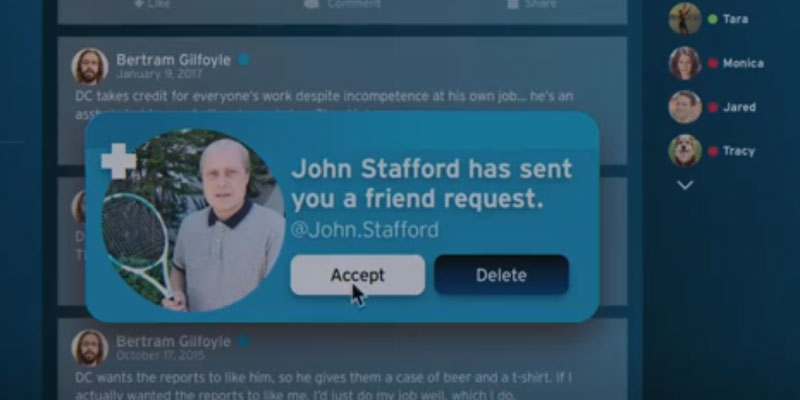
Henry Philips as John the server guy. His name is John Stafford. In this Season, his deadpan demeanor turns out to be a perfect foil to Gilfoyle's, and to Gilfoyle's chagrin, he even turns out to be better at chess than him.

Chris Aquino as Danny, formerly from Sliceline. Now in a relationship with Becky.

Rachel Rosenbloom as Becky, formerly from Optimoji. In a bickering relationship with Danny, in what appears to be a running gag.

Krishna Smitha as Priyanka Singh. There's nothing very interesting about this character. They basically recycled her in a gag that turned her from Monica's scapegoat to her downfall (in a very minor way). She's basically just a plot device prop here.

The Mood

It begins in a courtroom where Richard delivers an inspiring speech, followed by a celebration - seems to be a lot of that going around - back at Pied Piper's new office. Before long, politics rears its ugly head and the team finds itself in the thick of it once again. What happens next is a frantic race against time as they struggle again and again to keep disaster from striking. It always feels as though they're barely staying afloat, forced into one bad decision after another.

Finally, they triumph, but at a sad and terrible cost.

What I liked

Holy shit. The Season really starts off strong with Richard being both awkward and inspiring (in that order) on National Television. It's that speech he gives that turns disdain into admiration. It's amazing what Richard can do when he truly hits his stride.

"We are in the seat of the US government, a government that was founded by people who were, at one point, ruled by kings they couldn't overthrow. So, what did they do, right? They started over. They came here, to the New World. World 2.0, version 1776. And the way we win is by creating a new, democratic, decentralized Internet, one where the behavior of companies like this will be impossible, forever. One where it is the users, not the kings, who have sovereign control over their data. This, I promise to you: I will help you end this tyranny by building an Internet that is of the people, by the people, and for the people, so help me God."


Gilfoyle's AI is awesome. And it's hilarious how Dinesh manages to screw it up.

Colin's game engine eavesdrops on users and uses the data to run ads in the game itself. Hate to say this, but that's really creative, in a sick sort of way. Just wait till you see how Dinesh inadvertedly triggers a porn overload.


OMG, just look at Gavin Belson's presentation! HooliCares! HOOLISHEETS.

 The part where Hoover is conspiring with Denpok. First off, it's great to see how these two ultimately self-serving guys come together in the face of a common threat. Secondly, I love how Denpok always automatically picks the answer that makes him look good, then after a pause, gives the real answer.

The entire subplot with Pied Piper buying over Hooli is a gem. For one, we have basically the entire team working together like a well-oiled machine, which is what I watch Silicon Valley for. And for another, there are so many references to past Seasons. And thirdly, yes, this is yet another classic example of Gavin Belson fucking himself over due to pettiness.

Gilfoyle declares "I would rather do my own mother than Russfest". Which is funny if you recall that Gilfoyle despises his Mom.

Gilfoyle and John get along so well that John actually sends him a friend request through HooliSocial. And for a moment, Gilfoyle almost accepts. This is significant because it shows that Gilfoyle is not all impenetrable shell. Also, who's the "DC" he keeps slagging in the background? Dinesh Chugtai?

Monica and Gilfoyle plotting together is adorable. I also like Gilfoyle's mug. Totally in-character.

That visual gag of Gwart disappearing. It's kind of mean, but still funny.


While I do think the ending was a bit rushed, it was a decent ending to a wonderful series. It brought the entire arc to a close, and even perennial moral fuck-up Dinesh gets to play a part.

And all those celebrity cameos! Can't begin to name them all, but Bill Gates is a standout!

What I didn't

Richard could have kept his big mouth shut and just let Gavin hang himself using the rope produced by his own plagiarism. But damn, he has to have that satisfaction of exposition. And Gavin, being the evil genius he is, thinks on his feet and outsmarts Richard. Though it's really a Pyrrhic victory for Gavin because all he manages to do is escape. This whole scene was both funny and annoying at the same time.

True to form, this is how Richard appears on Jian Yang's mobile. Dude doesn't like anybody. But Monica's mobile, too? Ouch. I mean, it's funny and all, but it just doesn't make sense for Monica.


There's an awful lot of deadpan going around. From previous Seasons, it was mostly Gilfoyle and Laurie Bream. Now Gabe and John are getting into the act, as well as a few other minor characters. It's starting to become repetitive.

The ending feels a bit abrupt. It all screeches to a halt and we're treated to a time skip of ten years. It's all kind of jarring.

And damn it, where's Drew Daly in this one?!

Conclusion

Despite some flaws, Silicon Valley's final Season caps off six years of work in style. It's a fitting sendoff to everything that's come before. The characterization and events are largely consistent with how they've been portrayed in the past Seasons, and every main character gets a significant amount of air-time.

Silicon Valley would never have lasted forever, and it's great that it decided to quit while it was ahead.

My Rating


9.5 / 10

Time to pay the Piper!
T___T