Showing posts with label mobile app. Show all posts

Monday, 19 January 2026

Making the contact tracing effort mandatory, redux

Back in 2021, I wrote about the mobile app TraceTogether and its use during the COVID-19 pandemic. My rhetoric back then, in hindsight, was fiery; but I stand by what I said.

I had thought that this issue was behind us. However, last couple weeks, four entire years after I last mentioned it, the issue arose again in Parliament. A bill was passed - the Public Sector (Governance) Act (Amendment) Bill, which allows for sharing of citizens' data with bodies other than public agencies.

TraceTogether

During the debate, Opposition MP Kenneth Tiong brought up the fact that in 2021, Singaporeans discovered that data collected by TraceTogether could legally be shared with the police for the purposes of criminal investigation, and this had resulted in damage in terms of public trust. 

Minister of State for Digital Development and Information Jasmin Lau refuted this, and predictably, this led to a flurry of activity on my Facebook feed. Again, predictably, supports of the current ruling party, the PAP, stoutly re-iterated their trust in the Singapore Government, while supporters of the Opposition did the exact opposite.

Mostly incoherent sycophantic babbling on both sides, if I'm being honest. These days it feels like the most useless political opinions in the world can be found on Social Media. These political fanboys are nuts, and not even in a cool way.

My assertion back then

I was of the opinion that lives were at stake, and certain things such as privacy, had to take a back seat. I honestly do not consider there to be anything controversial about this statement, and would go so far to say that anyone who would knowingly endanger the lives of the public for the sake of their own privacy, is a selfish muppet.

Bring tracked.

Not that I suspect the Singapore Government to be the type to seize any opportunity to obsessively track its citizens like some kind of overbearing control freak Asian parent. However, the potential for abuse existed, no matter how small. The probability was a non-zero value. But it's no exaggeration when I say, if the Singapore Government's efforts to control the spread of COVID-19 led to them being able to track my whereabouts for the rest of my life, it was a tradeoff I would have taken. Happily.

However...

Certain quarters started spouting some ignorant claptrap in support of the ruling party. They claimed that anyone who objected to having their data tracked back then, had something to hide. Anyone whose conscience was clear surely would not object to having their data tracked for the greater good.

Oh FFS, children.

It's a principle of privacy. Yes, I'm sure there were those who had plenty to hide, but generally, people were objecting out of principle and not because they were planning to commit acts of moral indecency. Anyone who can't see that, either isn't familiar with the concept of principles, or has none to begin with.

Form-filling.

I had to deal with this principle several years ago when I bought an insurance policy. An insurance agent came to my place and proceeded to have me fill out a form as a matter of routine. Among the questions in the form were gems such as "have you contracted HIV or any STDs in the past year?" and the agent actually asked me this question out loud. In front of my mother.

Wow. This bloody idiot, I swear to God.

The answer was "no", but even if the answer had been "yes", did she really think it was something I would have been comfortable sharing in front of my own goddamn mother? It's the principle of the thing. Whatever happened to professional discretion? Did she somehow think that no one should be allowed to keep personal secrets from their own mother?

So yes... personal privacy as a principle is very real.

Comparisons

It's no comparison, of course. While the principle is the same, the stakes are vastly different. In the case of COVID-19, it was a global pandemic where public health and safety were at stake. In the case of that shockingly indiscreet insurance agent, it was merely a case of bureaucracy. Yes, I'm aware that it could be a lot bigger than that, but it still isn't on the level of public health and safety.

While I value my personal privacy, I don't value it over the lives of others. I certainly do not value anyone's personal privacy over the lives of others, and am mystified at the possibility that anyone could feel otherwise.

It's 2026. This really should be the final time I speak on this.

Not-so-privately,
T___T

Saturday, 1 November 2025

The year I finally achieved that JLPT certification

Some say "better late than never". I got a huge dose of that this year as I obtained my Japanese Language Proficiency Test (JLPT) N5 Certificate.

Why was this overdue? Well, you see, because I actually began on this journey at the tender age of 15. I was a Polytechnic student at the time, and this was a supplementary module. At first, things went well. Having received education in Chinese, learning the basic sounds of Japanese was a breeze. Learning the Hiragana and Katakana writing systems wasn't much of a stretch as well; in fact it was significantly easier than reading and writing Chinese characters. Until we got to Kanji, which essentially was Chinese characters.

Ugh, more Chinese.

At which point I lost all interest.

Also, at this time, I had begun an obsession with writing code, and building stuff. Japanese was a pretty language, but it just didn't fit into my world the same way C++, SQL or even QBasic, did.

And the rest, as they say, is history. Even after graduation, not only did I neglect whatever little Japanese I had learned, the next few decades were a disastrous collection of bad career choices, even worse lifestyle choices, and sobering life lessons.

COVID-19 and Clubhouse

Fast-forward to 2021. COVID-19 had the world in its loathsome grip and I, like many others, sought human interaction online. That was when I discovered the Clubhouse app. Through it, I encountered numerous communities, not all of which spoke English, Mandarin, or even Cantonese.

A few of these were Japanese speakers. And some were even offering Japanese lessons. I dove right in, relearning all the basics I had forgotten. Many times, I would simply listen in, try to make sense of the conversation, and Google words that came up. Then I started engaging, hesitantly, in the conversations. I even participated in Mandarin-Japanese exchanges!

Little cultural exchanges.

It was slow going. I wrote an app to facilitate relearning Hiragana and Katakana. I practiced writing every day, religiously. But there was this feeling that I could do more.

That was when someone suggested that I take the JLPT. And from that day forth, I took things up a notch.

Training in earnest

My next step was to install Duolingo on my phone. For the next few years, I faithfully partook of the exercises daily. At the same time, I went onto YouTube to search for JLPT Listening exercises. I didn't really have a sense of how far I had progressed; I just knew I needed to keep going. I've never been brilliant; but what I am good at is being consistent.

One year later, I downloaded the Migii app, and paid the subscription fees for accessing sample JLPT exam questions. With Duolingo, the returns were diminishing. I needed to train a different set of linguistic muscles - the kind used for passing the exam. Duolingo had brought me to a certain point where I could read the Japanese exam questions without too much difficulty... now I had to practice answering them.

The next milestone was hit another year later when, while watching a Japanese TV show, with English subtitles, I noticed something odd. Almost constantly, the subtitles would read "It's OK". Even though "It's OK" was a perfectly reasonable thing to say in the context of the current point of the story, it was a pretty poor translation.

Phrase Literal Meaning English Translation
daijobu It's OK. "It's OK."
dou itashimashite You're welcome. "It's OK."
shinpai suna Don't worry. "It's OK."
anshin shite Relax. "It's OK."
ki ni shinai de Pay it no mind. "It's OK."


At this point, I found myself thinking - wow, these translators are so goddamn lazy! They just use "It's OK" for everything!

And my next thought was - hey, if I know this much, shouldn't I be taking the JLPT already?!

The JLPT Test Voucher

That was when I registered for the JLPT on the Japanese Cultural Society of Singapore website. and paid a hundred Singapore dollars for the privilege. A month later, the JLPT test voucher arrived in the mail. The train was in motion; there was no going back.

Meanwhile, I continued training religiously. With Listening practice, especially. Online chatter had it that the recordings would be played only once, so I trained myself similarly, by not rewinding and replaying.

The JLPT N5 Exam

It was July when the day arrived. I head for the Singapore Management Institute where the exam was held, and stood in line with what looked like mostly Burmese folks. Interesting.

The invigilator who took charge of the exam room I had been assigned to, seemed to be Japanese going by the way she spoke English.

Shading answers with a pencil.

The proceedings were charmingly old-school. We were given question and answer sheets. It was all multiple-choice, and the correct answer had to be shaded with a pencil for feeding into a scanning machine. Despite my numerous certificates, I hadn't done this since... 2015? This was because my last couple certifications were earned from doing the coursework and presentations, rather than standardized tests.

The toughest moment in the exam came from the Choukai, which was the Listening portion. Despite my best efforts, my concentration slipped at various points. It was with considerable relief that I handed in my question and answer sheets, and headed off.

In August, I logged on to the JLPT portal to check my results. I had passed, and my results were more than decent. I actually scored higher on Listening than other sections!

The real value of all this

Last September, I got my actual physical certification through the mail. It was a foregone conclusion by that time, but I still felt that little thrill of pride. Job well done, bro, I told my reflection. Not such a big deal in the larger picture, but we've got to celebrate our wins even if they're small. Especially if said win took thirty-three friggin' years to achieve.

My results.

The JLPT N5 Certification isn't going to change my life. As far as professional cred goes, it's barely a blip. Achieving the JLPT N5 Certification probably puts me on par with the average Japanese toddler where the language is concerned. As for the value of understanding multiple languages? That's not much of a flex. This is Southeast Asia; just about everyone and their dog is multilingual.

No; at my age, the act of learning is arguably more important than what's being learned. It helps stave off dementia.

The real value is knowing and affirming, that with sufficient motivation and putting in the time and effort, I can learn pretty much whatever I choose to learn. And that is powerful stuff. In an age where things are constantly and rapidly evolving, the ability to learn shit has become vital - not just in the tech industry, but for life itself.

In hindsight, I should have realized this. How did I learn ASP? PHP? Ruby? VueJS? D3? All by picking up a book, watching videos, visiting websites, and constant practice. Most of the time, it really is that simple. The methods vary, but at the end of the day, it's about the willingness to put in the hours.

The linguistic journey continues!

I do want to see if I can achieve the next rung, the JLPT N4 Certification. Again, I'm not really sure why. Just for the hell of it, I guess. It's not like I plan to visit Japan. It's not like I realistically have anything to prove to anyone.

On the other hand, Korean does seem pretty interesting.

Decisions, decisions...

Ganbarimashoo!
T___T

Sunday, 1 June 2025

Rise of the Bike-sharing Phenomenon, Redux

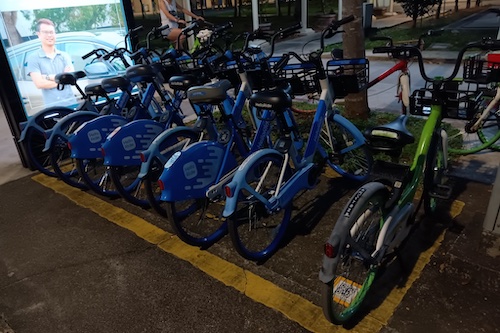
Almost exactly seven years ago, I wrote about bike-sharing apps and how they were making their presence felt in Singapore.

Those were some turbulent times, in the context of the bike-sharing industry, at least. Users flagrantly mistreated the bikes they rented. Due to problems arising from abuse of bicycle privileges and irresponsible parking, the Land Transport Authority (LTA) eventually mandated that bike-sharing companies would have to implement a QR code-based geo-fencing for designated parking, and gave existing bike-sharing companies a grace period in which to do so.

Cyclists in Singapore.

By the end of 2019, the majority of the companies I was talking about back then, have either been absorbed by bigger companies or left Singapore altogether due to challenges both technical and financial.

New players

As of 2025, two main companies remain. Anywheel was founded in 2017, and was a relatively small player at the time. It was only in 2019, when the dust cleared, that it began to establish itself as a major player. HelloRide, in contrast, was founded just a few years back in 2022 and only as recently as last year, received a full license to operate in Singapore

Having downloaded the Ofo app in the past, I gave the Anywheel app a go. The difference wasn't huge. Like the Ofo app, it basically included a feature to scan a QR code on the bike to unlock it, a way to relock and park the bike, and a payment interface.

Designated parking spaces.

The only real difference was the parking feature, and all it really involved was scanning a QR code at the parking spot. This is mystifying, because it doesn't strike me as anything the previous bike-sharimg operators wouldn't have been able to do. In light of this, it appears that at least part of the reason that the new players managed to meet the requirements at all, was with the cooperation of the LTA.

Same same but different?

Things seem to have improved. I no longer see bicycles thrown around nilly-willy. Once in a long while, I might see an abandoned bicycle in a canal, but these seem fewer and further in between, as compared to the old days. Perhaps Singapore as a society has grown. One can only hope.

Abandoned bicycle in canal.

And while there are markedly fewer choices, there's also a whole lot less chaos. Less mess, an improved technical implementation, and an overall better experience for the consumer. I am optimistic.


Let's ride!
T___T

Tuesday, 14 January 2025

App Review: Haunted Dorm

Think about all the tropes you've ever seen in Asian horror and even movies like the A Nightmare On Elm Street series and It. Think of all the times the characters triumphed over evil by virtue of their imaginations and teamwork.

And then download this game - Haunted Dorm, by China game company Mihuan, for a fun time.


This is a Tower Defense game with a single goal - to defeat the monster lurking the hallways before it comes for you. To that emd, you'll have all the classic tools for a Tower Defense; namely, missile weapons and resource generating items. The difference is that there is one main enemy to defeat. Sometimes there are multiple enemies, but only the demise of that one monster will win the game.

The Premise

The dorm is being haunted by a monster. You play as one kid in a group of children, going to a room and sleeping to gain enough resources. These resources will build your defences to hold off the monster's attacks, and eventually destroy it.


Once the monster breaks through the door of the room you choose, you're as good as dead and the game ends.

The Aesthetics

Haunted Dorm is rendered in what one would call "kiddy graphics". Everything looks hand-drawn and crude, like toddlers made this. It's a bold stylistic choice, though sometimes comes off as clunky.

The Experience

It's definitely a spooky experience, especially the first few days you play it. The atmosphere is haunting. The graphics are kiddy and this could end up either being comical or adding to the spookiness.


But there's also that sense of solidarity as you, the player, team up with other computer-controlled players to take down the monster.

The Interface

Drag your finger over the screen to move the avatar. Tap on buttons to perform actions. Select items to be built from menus.


It's not exactly complicated, though the execution feels clumsy.

There are also some items, like the machine gun, that you will need to tap and hold, and drag, in order to use. It's awesome, but not terribly intuitive.

What I liked

The music. It adds so much to the atmosphere, I can't rave enough about it.

Dream Hunter Mode. You get to play as the monster instead of the kids... and lemme tell you that this feature is fucking insane. Whereas in Normal Mode you had the aid of computer-controlled allies, in this mode it's the opposite - all these are working against you now. Still, what a feature!

Seven Monsters Mode. More interesting levels where you can't purchase Special Objects. This was pretty challenging.


Story Map Mode. Different rooms with different rules of engagement.

Ghost And Angels Mode. This is another mode where any allies who die, become a ghost as well. Good, chaotic fun!


The comments made when you steal stuff from other players, are amusing. Especially the awkward English translations of what was obviously Chinese text to begin with.


This solar beam is awesome beyond belief. Not only does it pinpoint the Monster's location, it deals damage and earns coins! And you can even upgrade it for bonus damage. Talk about overkill.


The entire game was ridiculously easy to play. Even with comically bad English translation, it was a breeze to just tap my way around and try shit out.


What I didn't

Unless you have the Trampoline, there really does not seem to be any way to escape what I call the Ghost Hole attack, or just spam-filling every square inch of the room, which can be super-tedious if you chose a large room.


The menu tends to go out of the screen sometimes depending on where you tapped the button. It's a layout issue and annoying AF. Do better!

Amy Can't Die Mode seemed like a waste of time. You basically sleep in one room with a bunch of other kids and you use your combined powers to hold of wave after wave of hostiles until you finally assemble a weapon strong enough to kill the Boss. It was an interesting concept, but the execution was so weak.


When there are objects appearing around the corridor, it's always a crapshoot as to what you'll end up grabbing before the others do. There's just so little time to react. At least give players and option to pick something else other than what they initially picked up!


I don't understand this game's obsession with frogs and toads. At all. It can be a little off-putting.


Conclusion

Haunted Dorm is simultaneously campy and goofy, and deliciously creepy. I found Normal Mode quite addictive and all the other features combined should provide great replayability. This is a game that doesn't take itself at all seriously, always a plus. One definitely could do worse than give Haunted Dorm a shot.

My Rating

6.5 / 10

Not spooktacular, but damn solid!
T___T

Monday, 2 December 2024

How much of the Artificial Intelligence hype is just hot air?

During an event held by Oracle in Singapore last month, I heard a speaker describe AI as "aspirin looking for a headache". On the other hand, Linus Torvalds was rather less poetic as he described AI, with characteristic bluntness, as "90% marketing and 10% reality".

The term "Artificial Intelligence" has infiltrated the public consciousness over the course of the past year. Tech products such as dating apps and search engines now boast AI-powered features. Even Meta's WhatsApp now has Meta AI built in, for no discernible purpose whatsoever. The consensus seems to be that adding the term "AI" to any product automatically raises its value in the eyes of consumers.

And sadly, they're right. Non-technical consumers tend to be a simple-minded bunch. On one hand, I feel like I should be outraged at this brazen exploitation of their gullibility. On the other hand, money needs to move in this economy, and if someone absolutely has to be parted from their money, it might as well be fools.

Shut up and take my money!

Is AI even all that revolutionary at the moment? Back in March, Sam Altman declared that OpenAI had produced ChatGPT 4 which had enhanced reasoning abilities. This report tells us that ChatGPT 4 beats 90% of humans. If we take this to be true, does it then follow that all the "AI-powered" features in other products up to now, have been bullshit?

As it turns out, very few people produce technology purely for the love of technology. It's a business like any other. And part of business, is hype. I can't go a day without seeing some ad for certification for AI pop up on my screen. My feed is full of news as to how AI is going to disrupt the workforce. It's starting to feel like people want this to happen a lot more than AI is actually capable of it. Because the perception of potentially huge profits, draws investors. Investors keep the money coming in. Few people have the patience to invest significantly in something that might be huge in a decade. However, if you can show progress now or soon, that's when the cash register sounds start ringing.

AI up to now

Currently, at the very basic levels, AI is being used in cheap entertainment. My Facebook feed is filled with the products of people amusing themselves with wacky AI image or video generations. Walls of text are similarly generated through idle conversations with bots.

At work, generative AI is used to rewrite paragraphs or even generate entirely new ones, in emails or in reports. Or create graphics for presentations. Even video. In short, nothing that wasn't possible before AI.

The problem is, the content generated can't be implicitly trusted. And even assuming that it can, such content generation isn't anything remotely groundbreaking. Creating presentations? Rewriting paragraphs and emails and cover letters? Bluntly put, it's kids' stuff. Unless your command of the English language was terrible to begin with, this use of generative AI won't increase quality of output. At best, the speed of which said output is produced, will increase tenfold. Quickly produced crap, however, is still crap.

When I first encountered ChatGPT, I regarded it as a fun new toy which could do amusing things like write poems, generate data about a known subject and make stuff up. And yes, even provide code for well-known algorithms. I certainly wasn't seeing ChatGPT as an equal, much less a threat to my professional existence.

The code generation capabilities were potentially interesting... but ultimately, nothing I couldn't accomplish with a Google search. And, of course, some judicious copy-pasting.

AI in the military?

If one were into conspiracy theories, we could even entertain the idea that AI is actually more advanced and being used by the military and secret organizations. The insipid content-generating version is the one that mere mortals like us are allowed to use, in order to distract us and lull us into a false sense of security. So while we're too busy using AI to genderswap our favorite movie stars and making crappy deepfake porn, some people are doing exactly what they want.

Depressing thought, eh? Anyway...


AI in the future

One question I keep getting asked is, will AI replace humans? Are our jobs in danger? Are programmer jobs in danger? I don't know, man. You've seen the state of Generative AI as it is now.

Text? We're talking about something that will cheerfully churn out chunks of text that looks reasonable but will probably not stand up to scrutiny. Just because something writes a lot of stuff in good English, doesn't mean the stuff is actually useful.

Images? You mean the art generators that keep rendering human hands with entirely too many fingers? The amount of effort it takes just to generate one useful image (which can never be replicated) is off-putting unless you're just doing it for recreational purposes. As for video, forget about Sora and its ilk replacing actors and film directors. The observations I made about art generators above, applies here, too.

If you can be replaced at your job by technology that produces such unusable rubbish, perhaps AI isn't the problem. Perhaps the problem is that your job is so repetitive and needs so little human ingenuity that a machine could do it, and do it a million times faster.

The other possible problem, in the case of artists and writers, is that consumers are Phillistines and don't require content to be all that good. They're happy with sucky AI generated monstrosities, as was the case recently when a local artist's work was plagiarised with AI.

This is not to say that AI will not eventually replace us. "Eventually" being the operative word. For this to happen, AI would have to hit some kind of critical point. Self-programming? Learning new logic instead of simply adding data to its memory? Actual creativity instead of merely approximating existing data from human beings?

And the golden question: When will this happen?

I don't know the answer to that question. No one does. There are too many possibilities. It could happen a hundred years from now. Or fifty. It could happen next week, or even after breakfast tomorrow. The only thing that's clear is, in its current form, AI is not even remotely close to being an average human replacement. However, once it arrives at that critical point, not only will AI have that human spark, it will have the speed gifted to it by technology. As to what would happen next, use your imagination.

In King Arthur's
Court.

This reminds me of a novel I once read, by Mark Twain, A Connecticut Yankee in King Arthur's Court. In the story, Hank Morgan time travels and finds himself in Camelot, making the acquiantance of the likes of Arthur, Merlin and Lancelot. The medieval English are initially hostile, but Morgan has a gun on him, and uses it to devastating effect. To the people of these times, this looks like powerful magic even though to us it's just, you know, a gun. They end up worshipping him as some kind of great wizard while Merlin looks jealously on.

Because, as we know, technology that is sufficiently advanced, is indistinguishable from magic.

Just for readers who are terrible with analogies, here are several parallels I can draw from that story to this situation. Generative AI looks like the gun. The promoters of AI technology such as Jensen Huang and Sam Altman, are Hank Morgan. And the rubes gushing about how transformative this new technology is, are, tragically, those primitive and technologically backward Englishmen.

Conclusion

Artificial Intelligence may or may not be increasing in actual technological depth, but its mentions are becoming increasingly ubiquitous, if not its actual usage. Time will tell if all this is smoke and mirrors.

Right now, with all the hype, AI doesn't actually need to be that good in order to gain traction. Perception is a huge part of this. As long as there are rubes around willing to uncritically swallow what the snake oil peddlers are selling, there'll be enough goodwill to carry it. But even that goodwill is going to run out at some point. By that time, let's see if AI has made any actual progress.

Maybe all these people who are hyping this up, who don't appear to have ever written a single line of code in their lives, are seeing something I'm not. I remain open to the possibility that I'm wrong about this. I want to be wrong about this. It would be beyond exciting if so.

Artificial regards,
T___T

Tuesday, 17 September 2024

App Review: Duolingo

Today, I want to review an app that I've been using for the past couple years. Duolingo is a language-learning app that provides lessons on reading, writing, pronounciation and grammar, for over forty different languages.


For the past year, I have been regularly using Duolingo to work on my Japanese. As with most other activities, prolonged use comes with diminishing returns. However, Duolingo still represents significant value for me, and I'd like to examine it in some detail.

The Premise

When you sign up for an account, Duolingo tests you in that language to assess how far along you are in your learning journey. From there, it places you either right at the beginning, or somewhere further along the path.


From there, you complete modules that have been grouped into two basic groups - reading and writing, and grammar.

In the case of Japanese, reading and writing is further sub-categorized into Hiragana, Katakana and Kanji. This will take the form of character recognition, and actual writing.

For grammar, it's more along the lines of forming sentences, learning new words and concepts, and translating from Japanese to English. And recently, they even added speaking lessons!


Duolingo is partially gamified. As the users learn, they gain XP which can be used for extra challenges and unlocking features like Personalized Planning. Users are also placed in Leagues - Copper, Silver, Gold, Sapphire, Ruby, Emerald, Amethyst, Pearl, Obsidian, Diamond - and even a sort of Elite-level league within the Diamond League.

The Aesthetics

The layouts are clean and straightforward, with a cutesey bent. Check out the art on these medals!


The animations are pretty cute, especially at the end of each lesson.

The Experience

Even just exploring the app for the first time, I navigated it with ease. I managed to find extra information by clicking on stuff during exercises, such as explanatory text.


Also, there were charts and wordy descriptions hidden away, accessible by clicking the correct screen elements to open them up. They were almost a bit too well hidden, because I only really discovered them half a year into using Duolingo.

All in all, this did not require a huge learning curve to use.

The Interface


The user tends to be clicking buttons on most of the screens. It's mostly arranging words to form sentences or multiple-choice questions.


In the case of writing exercises, there's a drawing component.


For speaking exercises, tap the mic and read the text provided. It's all pretty simple, hard to go wrong.

What I liked

This app keeps getting revised as the creators refine their teaching techniques, adding new question types every now and then.

I love this particular puzzle. It's mad (just like its name), yet so addictive.


This timed challenge isn't bad either.


This avatar maker seems totally superfluous if I'm being honest, but I totally love it!


I like the fact that Listening and Speaking exercises are totally optional and can be turned off when encountered.


While I'm not wild about the concept of Hearts (you need at least 1 Heart to do the lessons), there's at least a practice option that can be used without Hearts, to earn Hearts. I understand why it is the way it is, because Duolingo is ultimately a business and users need to be encouraged to use the Pro version. Doesn't stop it from being annoying on occasion!


Friend Quests are great. Nothing like teaming up with someone else once a week, to meet some objective or other. This is so cool!


Gems. While I think they're kind of superfluous, I can't seem to stop obsessively collecting them by doing challenges, completing Quests, watching ads, and so on. I tend to console myself that at least with all this ad watching, I'm making up for the fact that I haven't yet spent a cent on this app.


I live for Duolingo telling me I've extended my streak!


The concept of Super is nice. It adds considerable value to users who have money to spare.


Just the entire concept of Duolingo, to be honest. It's hard to have negative thoughts about an app whose intention is to educate. The intention is to be lauded, both in terms of intent and scope. Over forty languages is nothing to sniff at.

What I didn't

Some of the voices are extremely annoying. The voices of the kids - and this may be just my opinion - are high, shrill, and somehow louder.

I like encouraging my friends and all, but having a list of different emojis to do it with, feels like overkill.


Having a listening Daily Quest seems a little insensitive towards the deaf.


One main limitation of Duolingo is that it uses English almost exclusively as a base. If you are trying to learn English, then yes, you can use one of the other languages as a base. However, you can't, for example, learn Japanese using Mandarin.

Sometimes there are glitches in the interface. Mostly layout problems, probably easily fixed.

I think the concept of using English to type in romanization for sounds, is more than a little annoying when you factor in Autocorrect. Plus, I really don't think it adds much to the education.


Just the general gamification of the experience seems a little off, somehow. I suspect the app would be better with its exclusion. In particular, I detest the Leaderboard.


The entire concept of XP also gives me the eye-rolls. This goes for related functionality like Legendary, Saturday XP Bonus Hour,  and so on. A guy just wants to study Japanese, why do I need this? Why does anyone need this? It's a distraction, nothing more.

There's also an issue with Duolingo that has been making the rounds on Social Media a while now. And that's the inclusion of LGBT themes in the training material. Before anyone gets their panties in a bunch, I think inclusivity is a wonderful thing, and I certainly won't criticize it on a platform that I'm not even paying for. However, the heavy-handed way Duolingo goes about it, is problematic.


Take the above screenshot, for instance. It's that of a butch-looking woman (with a woman's voice) telling us about her wife. Now, butch lesbians exist because LGBT is a fact of life regardless of legality. Muslim users can complain all they like; it is what it is. But I do object to sentences such as "My older brother's husband is Canadian.".

You see, same-sex marriage has not been recognized in Japan as of now. That is also a fact of life. And to act like it's mainstream in Japan via means of the training sentences, strikes me as supremely disrespectful of another country's right to determine their own laws without outside interference. The makers of Duolingo are not Japanese, are not natively familiar with the culture, and have no business trying to impose their ideals here no matter how noble their stated intentions seem. As of last June, they've already gotten into trouble with Russia about this. 

Conclusion

This app is great for learning a new language. It won't give you native-level fluency, but it will absolutely take you from zero to some significant level of proficiency provided one uses it diligently and consistently. Duolingo is probably excellent as a supplementary means of learning. Or even a main means of learning if, like me, you're just a casual.

Great as the concept is, however, there remain several implementation problems that, in all fairness, are ironed out with regularity. With the regular addition of new features, inevitably, there will other implementation issues, but hey, it won't get stagnant. That's a huge plus!

Regardless of what I think about Duolingo's attempt at incorporating progressive politics (and make no mistake, I think it's misguided at best), Duolingo remains one of the most recognized language-learning aids today. And if they sensibly keep those politics as a feature rather than the feature, this should not change anytime soon.

My Rating

7.5 / 10

This app speaks to me!
T___T