Showing posts with label Sundar Pichai. Show all posts

Saturday, 25 May 2024

Googlers Fired For Protesting Project Nimbus

Google is in the news again for firing people, and this time it's a little different. Just last month, Google dismissed 50 staff members for being involved in protests against Project Nimbus - Amazon and Google's cloud computing services deal with the nation of Israel. 

For those who've been living under a rock, Israel and Palestine are at it again. The how and when are going to need more time than you have to read this blogpost, so let's move on. Suffice to say, the concern is that Project Nimbus will have military applications, even if this is not the expressed intent of Google.

Mixed feelings about the Googlers

I'll begin by saying that yes, I agree with CEO Sundar Pichai, politics should be kept out of the workplace. If you don't like what your company is doing and can't square it with your conscience, just leave. Don't be a drama queen about it. Especially, don't use the time that the company is paying you for, to work against the company itself. Amazon employees protested Amazon's involvement as well, but at least that was only in the form of a signed petition. 

On the other hand, Project Nimbus sounds all kinds of dangerous. AI to profile people in Gaza? Possible military application? Huge potential for abuse. I don't blame the Googlers for not wanting any part of it. That goes double for if these Googlers are Muslim, or Palestinian. Seriously, why would Google even think it would be OK for a Muslim to aid Israel? There's only so far you can push the concept of "professional obligation".

An ominous cloud.

All that said, while their former staff might have been behaving in a manner that was less than professional, there's this part of me that thinks Google absolutely asked for it.

All these years, Google has been painting itself as this ultra-progressive place where their work shapes the world. They hired young idealistic types with self-righteous mantras such as "Don't be Evil" and "Do The Right Thing". The very kind of people who would be expected to dig their heels in if Google strayed from their perceived path of not being evil.

And now they object to this behavior? Come on, that's bullshit. Google made that bed, and now they get to lie in it.

About this whole Israel-Palestine thing...

I've had more than one person telling me that this Israel-Palestine issue should not be characterized as a "conflict" or a "war", and that doing so is disingenuous and downplays the fact that Israel is committing "genocide". OK, let's say that this is true. Let's say that the level of fuckery going on in that part of the world is off the scale.

But the Russia-Ukraine war is still going on. Pretty sure that hasn't been settled yet. People are still dying.

There's also whatever is allegedly going on in Xinjiang, China. Western media tells us it's a genocide, though at this point I trust Western media about as much as I trust China's. But again, let's assume it's true.

And Myanmar. After that coup back in 2021, the injustices are still happening, aren't they? Myanmar hasn't been somehow liberated while we weren't looking.

War is everywhere.

My question is; why do these people talk like the Israel-Palestine thing should matter to me the most? I get that if someone is Muslim or Jewish, without question, this should matter to them. And even if they're not Muslim or Jewish, they should be able to care about this issue as much as they wish.

But why me? Why do people insist that I care about this over everything else that's happening?

Human Rights violations? It's the humane thing to do? Children are dying? Shit, one could make the same argument about Russia-Ukraine, or Xinjiang, or Myanmar. I realize that this sounds horribly cold, but what makes Israel-Palestine special? Or is this just a case of "I care because I'm a good person, and if you were a good person, you'd care too"?

And if the answer is, no, I don't have to choose, I should care about all this equally? Sorry guys, I don't have the kind of bandwidth required to study the history of all these conflicts. I actually have a job, unlike those former Googlers (low blow, couldn't resist, heh heh) and shit I need to handle. At some point, we all need to choose what to spend our time and energy on. Yes, this sounds like a cop-out, but that doesn't make it any less true.

If they want people to prioritize this, a compelling reason is needed. And no, "be on the right side of history" (whatever that dumb shit even means) does not count. You guys realize that there is no "right" side of history, right? No matter what you do, or don't do, a hundred years from now, some snot-nosed kid is going to read a history book and judge you for it. The same way youngsters are now judging the likes of Abraham Lincoln, Lee Kuan Yew, and so on.

Conclusion

No two ways about it - in this story, everyone's an asshole.

Google, not for their business dealings with Israel. Project Nimbus is pretty disturbing, yes, but they're a company and they don't owe anyone an explanation as long as it's legal. But for hiring woke and passionate people who will absolutely put their passion over common sense, almost encouraging them to act that way, and then having the unmitigated gall to take exception when they inevitably do so? Total dick move.

The people who got fired, also did their best to make it happen. Shit, how did they think it was going to go down? Did they think Google was going to cave in to the pressure and beg for forgiveness? Google's been laying people off; they were probably grateful for the excuse.

No silver lining in this cloud!
T___T

Thursday, 25 June 2020

Making the contact tracing effort mandatory

Singapore is still in the middle of the COVID-19 battle; indeed, so is the rest of the world no matter what New Zealand claims. All due respect to NZ, but as long as an effective vaccine has not been created, the war is not over and all celebration is premature.

To that end, Singapore is intending to distribute the wearable TraceTogether token, which functions pretty much like the app of the same name. The app, along with the SafeEntry app (which is basically an online form called by scanning a QR code - rudimentary but effective) were rolled out the past few months as aids to help the contact tracing effort. However, they have not been altogether adequate.

The TraceTogether app

This app uses the Bluetooth feature on mobile phones, tracking all similarly enabled mobile phones within a radius. Therefore, in theory, one should be able to trace whomever an infected user was in close contact with.

Using TraceTogether.

Unfortunately, this does not work so well on iOS devices, and even on Android devices. It also has the annoying side-effect of hogging the Bluetooth signal. As long as this app is on, your mobile can't use Bluetooth for anything else.

Also, the older population may not be tech-savvy enough to actually know how to use a mobile phone, much less install an app.

The SafeEntry app

This solution is deployed at the entrances of all buildings, and every shop within a mall. Upon entry, the user is supposed to scan the QR code, go to the page and click the "Check-in" button after entering details such as NRIC and mobile number. Upon exit, the user should click the "check-out" button.

SafeEntry is useless in the open.

Not only is this troublesome AF, it's all too easy to forget to "check-out". And one can even more easily lose track of all the places checked in at. Just try going to any building from the underpass at Orchard MRT.

In addition, this method is deployed only at entrances of businesses. Meaning, it doesn't do jackshit to help trace people who might have contracted COVID-19 out in the open.

What the TraceTogether token solves

Basically, anything that involves considerable conscious effort on the part of the user, is suspect. People are human; they get lazy and slipshod. Wearing the token ensures that tracking will be done everywhere, without the need to install apps or click buttons.

Along with that, the Singapore Government might be about to make the wearing of this token mandatory; that is, if you are found not to have that token on your person, you will be fined and/or jailed. This has predictably raised a ruckus, with people signing some lame petition against it, just about guaranteeing that the law will be passed.

People are concerned, despite pretty much handing their data over to Facebook and Google every time they use their mobile phones (or even when they don't), that the Government will abuse this privilege to track their every movement. They're concerned for their freedom and privacy. They'd rather let the likes of Mark Zuckerberg and Sundar Pichai take their data for profit, but not their own Government who are trying to save their lives. Some have even suggested that the Government is using this outbreak as an excuse to implement a surveillance state.

Are you guys for real?!
Oh FFS, children. Grow up!

The token doesn't check your location. It checks who was in close contact with you. That's a whole different kettle of fish. I've found that most of the people raising a fuss aren't technically inclined... the techies I know aren't concerned in the least. Because we actually know shit, and we know this doesn't do what you think it does!

And even if it does track your every movement...

Maybe I haven't made myself perfectly clear the last few times I wrote about this, but fuck your precious privacy. Lives are at stake. In case you've been living under a rock and don't know what we're dealing with here, COVID-19 is a very infectious disease which can lead to death. The fact that only twenty-plus people have died out of a possible forty thousand infected in Singapore so far, is no reason to be complacent.

COVID-19, on its own, is not that deadly a disease. However, it is extremely contagious and Singaporeans behaving like utter retards at every opportunity makes this disease even more dangerous than it already is. We're stupid and ill-disciplined, and will willingly disregard self-preservation and the safety of others for instant gratification. That's what the past few months of observation have shown me.

If the TraceTogether token is not made mandatory, that means much faith has to be placed in the hands of Singaporeans to do the right thing for the greater good... and I'm not at all sure we're deserving of that amount of faith.

Oh, the COVIDity!
T___T

Sunday, 4 November 2018

A Walkout Against Tech Discrimination

It never rains, but pours.

And for Google, it's been a veritable monsoon. From the Damore debacle to getting successfully sued by Oracle, Google has been facing an increasing avalanche of problems. The Silicon Valley giant found itself the subject of a massive walkout staged by its own employees all over the world last week, in response to revelations of sexual misconduct from male staff and how Google handled (or mishandled, depending on who you ask) these cases.


One particular case stands out. Andy Rubin, known as "Father of Android", was asked to leave a few years ago when the company discovered that he had sexually assaulted a colleague. The severance package was 90 million.

Now, if Google had been under legal obligation to pay that amount, this wouldn't have been an issue. But then-CEO Larry Page appeared to have covered up the entire incident for fear of negative press, and paid Rubin to keep him quiet. And in these times, the SJW culture in Google, fostered quite handily by current CEO Sundar Pichai, simply wouldn't stand for it.

Thus, the walkout.

It started in Google's offices in Asia, such as Singapore. And then those in the US and Canada joined in. Several more countries are on the list, but hell if I'm going to name them all. Employees left their desks in droves at 11 AM, gathering outside or in lobbies to protest against the actions taken to protect these sexual predators, with a specific list of demands.


Cute flyer, eh?

The Demands

An end to forced arbitration in cases of harassment and discrimination. Sure, I can get behind that. Harassment and discrimination (especially the former) is too big to be buried. Deal with it openly and fairly. Involve the law, if need be.

A commitment to end pay and opportunity inequity, for example making sure there are women of color at all levels of the organization, and accountability for not meeting this commitment. Oh, really? That kind of bullshit is ruinous. Ending pay and opportunity inequity is a fine and noble goal; artificially putting people in place based on gender and race is discriminatory... and an insult to women of color who actually earned their spot.

A publicly disclosed sexual harassment transparency report. Well and good. Easy to do, I'd imagine. Provided nobody tries to, ahem, hush things up.

A clear, uniform, globally inclusive process for reporting sexual misconduct safely and anonymously.
HR would have to seriously pull its socks up, and be afforded more autonomy overall. Not easy by any means, but doable.

Elevate the Chief Diversity Officer to answer directly to the CEO and make recommendations directly to the board of directors. In addition, appoint an employee representative to the board. Oh, fuck off. A "Chief Diversity Officer" sounds like a stupid idea in the first place. Why the obsession over diversity? Google does not need less men or more women; they need more employees who don't disrespect their colleagues, period. And they need management who will enforce the rules effectively with neither fear nor favor.

How did it get to this?

First off, let me just say that the prevalence of males over females in the tech scene is more a Silicon Valley problem rather than a specifically Google one. But hey, we all gotta start somewhere.

Next, a company of Google's size notoriously difficult to police, and it ought to be. Sure, they can have policies in place. Fat lot of good it did with Uber, if you recall. As long as higher management disregards these rules at any point in time for whatever justification, it's all moot. Larry Page' actions have come back to bite Google in the ass, and I can't say I'm sorry about that. Sure, my disdain for the SJW culture in Google is well-documented, but my antipathy towards those who abuse their authority to coerce colleagues into sexual favors is far greater.

Google did not get themselves into this position overnight. It was built up over generations of hiring the wrong kind of people, and lax enforcement of mutual respect in the workplace. No amount of hysterical SJWs clamoring for justice is going to change that unless higher management changes their approach, prioritizing employees over the company's pristine (well, now not so pristine) image and PR. I've said it before - Google is a profit-driven corporation trying desperately to appear socially conscientious while struggling with issues such as alleged pay disparity between males and females, gender discrimination and now sexual misbehavior. My opinion is that they tried too damn hard to maintain that image, even at the cost of their ethics, and it backfired. Spectacularly.

What now?

Sundar Pichai is coming off as placatory in his statements, and it's hard not to feel a little sorry for the guy. Sure, he didn't make things better, but let's be fair - he inherited the situation in 2015. He didn't ask for any of this, and whatever changes he might have wanted to make would have to pass the Board of Directors, whose main concerns are profits and the aforementioned PR. That SJW culture he seems to have tacitly encouraged during his tenure is now rising up to put an end to the charade.

This is just coming from some nobody software dev from the tiny island of Singapore, but I say - practice what your motto preaches. Do The Right Thing - over and over - and the rest will slowly but surely follow. For now, of course, ol' Sundar can only hope to survive the fallout from this. There are no quick fixes.

That's all from me. Over and (walk)out!
T___T

Thursday, 21 September 2017

Web Tutorial: The Anti-CSRF Token

Today's web tutorial is security-based, and it's one of the most elementary things you should know about when developing web applications.

I will be demonstrating a very simple Cross Site Request Forgery (CSRF) attack, and detailing how to foil it. Most frameworks already include this protection, but I would not recommend relying exclusively upon this protection without at least a rudimentary understanding of how it works.

A CSRF occurs when one party outside of your web application's domain makes a request to your web application, mimicking all the necessary data needed for the request to be processed. If that sounded like gibberish to you, maybe the diagram below will help.

CSRF attack diagram


And if that still doesn't help, no sweat. I'll be walking you through an example.

Take this PHP code. I'm not going to explain every line because that's not the purpose of this tutorial. Basically, this code makes a request to tx.php to return some data.
index.php
<!DOCTYPE html>
<html>
    <head>
        <title>CSRF Test</title>
    </head>
    <body>
        <form method="POST" action="tx.php">
            Show transactions with:
            <select name="ddlTxWith">
                <option value="0">Sundar Pichai</option>
                <option value="1">Mark Zuckerberg</option>
                <option value="2">Steve Jobs</option>
            </select>
            <input type="submit" value="Go">
        </form>
    </body>
</html>


This is what you should see when your server runs it. Here, I'm assuming that the intended user is already logged in. You have a drop-down list with three big names, and clicking the "Go" button will reveal all the transactions you've had with the selected person.


Now, this code defines a multi-dimensional array, simulating some data from a database. It takes the value of the drop-down list submitted, and uses it to grab the required data.
tx.php
<?php
$TxWith = -1;
$TxObj = array();

$Tx = array();
$Tx[0][0] = array("Date"=>"20 May 2010", "Amount"=> 200, "Comments" => "10-course dinner");
$Tx[0][1] = array("Date"=>"5 July 2016", "Amount"=> 10500, "Comments" => "Website fees for Google domain");
$Tx[0][2] = array("Date"=>"18 June 2011", "Amount"=> 50, "Comments" => "Monthy Gmail fee");

$Tx[1][0] = array("Date"=>"10 July 2011", "Amount"=> 660, "Comments" => "Facebook ad registration");
$Tx[1][1] = array("Date"=>"10 September 2011", "Amount"=> 2, "Comments" => "Starbucks coffee");

$Tx[2][0] = array("Date"=>"10 June 2010", "Amount"=> 2500, "Comments" => "Apple design");
$Tx[2][1] = array("Date"=>"12 June 2012", "Amount"=> 1200, "Comments" => "iOS Seminar Booth");
$Tx[2][2] = array("Date"=>"5 August 2015", "Amount"=> 2000, "Comments" => "iPad");

if (isset($_POST["ddlTxWith"]))
{
        $TxWith = intval($_POST["ddlTxWith"]);
        $TxObj = $Tx[$TxWith];
}

?>

<!DOCTYPE html>
<html>
    <head>
        <title>CSRF Test</title>
    </head>
    <body>
        <?php
        if (sizeof($TxObj)>0)
        {
            for ($i = 0; $i< sizeof($TxObj); $i++)
            {
                echo "Date: " . $TxObj[$i]["Date"] . "<br />";
                echo "Amount:  $" . $TxObj[$i]["Amount"] . "<br />";
                echo "Comments: " . $TxObj[$i]["Comments"] . "<br />";
                echo "<br />";
            }
        }
        ?>
    </body>
</html>


So, for example, if you select "Steve Jobs" and click "Go", this is what you get. Yes, I know in the real world, Steve Jobs is not going to pay me $2000 for an iPad (besides, the dude is dead), but I can dream, right?


Here comes the attack!

Now, on a separate folder, which we'll call csrf_attack, let's create index.html. That's right, you don't even need sever-side code to do a CSRF. Scary, huh?
index.html
<!DOCTYPE html>
<html>
    <head>
        <title>CSRF Attack</title>
    </head>
    <body>

    </body>
</html>


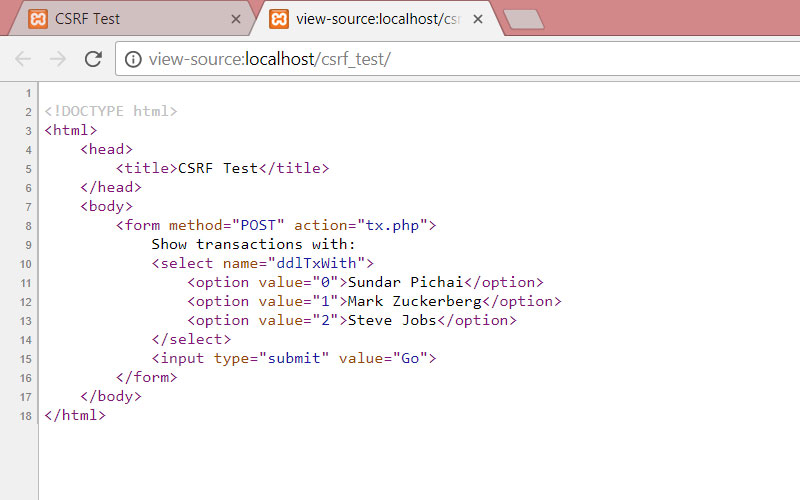
OK, there's a blank HTML template right there. How do we know what variables to send? Well, assuming you had an account for that web application in csrf_test, you could view the source and get this...


That's just one way out of a multitude of rather more sophisticated (and automated) methods. I'm just using the most obvious way.

So after that, we use the code! Note that in the action parameter of the form tag, we've set it to submit the request to the site we're attacking. In this case, it's localhost/csrf_test/tx.php.
index.html
<!DOCTYPE html>
<html>
    <head>
        <title>CSRF Attack</title>
    </head>
    <body>
        <form method="POST" action="http://localhost/csrf_test/tx.php">
            <select name="ddlTxWith">
                <option value="0">Sundar Pichai</option>
                <option value="1">Mark Zuckerberg</option>
                <option value="2">Steve Jobs</option>
            </select>
            <input type="submit" value="Go">
        </form>

    </body>
</html>


Open this up in another browser. I'm using Chrome for csrf_test, so let's go with Firefox for csrf_attack.


Now click Go, and you have all the transactions with Sundar Pichai! That's data that you, as an attacker, have no right to. Viewing unauthorized data is damaging enough; imagine if your request actually involved editing, adding or deleting data. Or, if this page actually allowed a user to perform transactions, an attacker could use this to send money from the victim to himself.


Foiling the attack

The recommended way is to use an anti-CSRF token, one that the attacker cannot replicate. You could use a randomly-generated token... or you could use one that has already been provided by you, via PHP's session token.

So do this. It begins a PHP session. Ordinarily, you would already have this code, if the page handled user logins.
index.php
<?php
session_start();
?>


<!DOCTYPE html>
<html>
    <head>
        <title>CSRF Test</title>
    </head>
    <body>
        <form method="POST" action="tx.php">
            Show transactions with:
            <select name="ddlTxWith">
                <option value="0">Sundar Pichai</option>
                <option value="1">Mark Zuckerberg</option>
                <option value="2">Steve Jobs</option>
            </select>
            <input type="submit" value="Go">
        </form>
    </body>
</html>


Add this to the HTML portion. It's a hidden field, with the session id embedded. For extra security, we'll hash it with MD5 encryption.
index.php
<?php
session_start();
?>

<!DOCTYPE html>
<html>
    <head>
        <title>CSRF Test</title>
    </head>
    <body>
        <form method="POST" action="tx.php">
            Show transactions with:
            <select name="ddlTxWith">
                <option value="0">Sundar Pichai</option>
                <option value="1">Mark Zuckerberg</option>
                <option value="2">Steve Jobs</option>
            </select>
            <input type="submit" value="Go">
            <input type="hidden" name="hidCSRF" value="<?php echo md5(session_id()); ?>">
        </form>
    </body>
</html>


View your source. See that hidden field with "f7c6332b0ec5529210f7959a0d304521"in there? That's the MD5 hash of your unique session id.


Now, in tx.php, we'll start a session as well.
tx.php
<?php
session_start();

$TxWith = -1;
$TxObj = array();

$Tx = array();
$Tx[0][0] = array("Date"=>"20 May 2010", "Amount"=> 200, "Comments" => "10-course dinner");
$Tx[0][1] = array("Date"=>"5 July 2016", "Amount"=> 10500, "Comments" => "Website fees for Google domain");
$Tx[0][2] = array("Date"=>"18 June 2011", "Amount"=> 50, "Comments" => "Monthy Gmail fee");

$Tx[1][0] = array("Date"=>"10 July 2011", "Amount"=> 660, "Comments" => "Facebook ad registration");
$Tx[1][1] = array("Date"=>"10 September 2011", "Amount"=> 2, "Comments" => "Starbucks coffee");

$Tx[2][0] = array("Date"=>"10 June 2010", "Amount"=> 2500, "Comments" => "Apple design");
$Tx[2][1] = array("Date"=>"12 June 2012", "Amount"=> 1200, "Comments" => "iOS Seminar Booth");
$Tx[2][2] = array("Date"=>"5 August 2015", "Amount"=> 2000, "Comments" => "iPad");

if (isset($_POST["ddlTxWith"]))
{
        $TxWith = intval($_POST["ddlTxWith"]);
        $TxObj = $Tx[$TxWith];
}

?>

<!DOCTYPE html>
<html>
    <head>
        <title>CSRF Test</title>
    </head>
    <body>
        <?php
        if (sizeof($TxObj)>0)
        {
            for ($i = 0; $i< sizeof($TxObj); $i++)
            {
                echo "Date: " . $TxObj[$i]["Date"] . "<br />";
                echo "Amount:  $" . $TxObj[$i]["Amount"] . "<br />";
                echo "Comments: " . $TxObj[$i]["Comments"] . "<br />";
                echo "<br />";
            }
        }
        ?>
    </body>
</html>


And then we'll add an If conditional block to check if the MD5 hash of your current session id matches the one you sent in the form!
tx.php
<?php
session_start();

$TxWith = -1;
$TxObj = array();

$Tx = array();
$Tx[0][0] = array("Date"=>"20 May 2010", "Amount"=> 200, "Comments" => "10-course dinner");
$Tx[0][1] = array("Date"=>"5 July 2016", "Amount"=> 10500, "Comments" => "Website fees for Google domain");
$Tx[0][2] = array("Date"=>"18 June 2011", "Amount"=> 50, "Comments" => "Monthy Gmail fee");

$Tx[1][0] = array("Date"=>"10 July 2011", "Amount"=> 660, "Comments" => "Facebook ad registration");
$Tx[1][1] = array("Date"=>"10 September 2011", "Amount"=> 2, "Comments" => "Starbucks coffee");

$Tx[2][0] = array("Date"=>"10 June 2010", "Amount"=> 2500, "Comments" => "Apple design");
$Tx[2][1] = array("Date"=>"12 June 2012", "Amount"=> 1200, "Comments" => "iOS Seminar Booth");
$Tx[2][2] = array("Date"=>"5 August 2015", "Amount"=> 2000, "Comments" => "iPad");

if (isset($_POST["ddlTxWith"]))
{
    if (md5(session_id()) == $_POST["hidCSRF"])
    {

        $TxWith = intval($_POST["ddlTxWith"]);
        $TxObj = $Tx[$TxWith];
    }
    else
    {
        echo "You are not authorized to view this data.";
    }

}

?>

<!DOCTYPE html>
<html>
    <head>
        <title>CSRF Test</title>
    </head>
    <body>
        <?php
        if (sizeof($TxObj)>0)
        {
            for ($i = 0; $i< sizeof($TxObj); $i++)
            {
                echo "Date: " . $TxObj[$i]["Date"] . "<br />";
                echo "Amount:  $" . $TxObj[$i]["Amount"] . "<br />";
                echo "Comments: " . $TxObj[$i]["Comments"] . "<br />";
                echo "<br />";
            }
        }
        ?>
    </body>
</html>


Try your code again. See if you can still get all of the transactions with, say, Mark Zuckerberg? There should be no change to the results. It should all be transparent to the user.


Now let's attack again!

Let's grab the code and add it to your index.html. Yes, even the hidden field.
index.html
<!DOCTYPE html>
<html>
    <head>
        <title>CSRF Attack</title>
    </head>
    <body>
        <form method="POST" action="http://localhost/csrf_test/tx.php">
            <select name="ddlTxWith">
                <option value="0">Sundar Pichai</option>
                <option value="1">Mark Zuckerberg</option>
                <option value="2">Steve Jobs</option>
            </select>
            <input type="hidden" name="hidCSRF" value="f7c6332b0ec5529210f7959a0d304521">
            <input type="submit" value="Go">
        </form>

    </body>
</html>


Run it. Then try to get all transactions with Steve Jobs. Bingo! The attacker gets nothing, because tx.php's unique session id for the attacker did not match the one sent in the form!


What if the attacker could get hold of the actual session id that a user is currently using?

Good thinking!

But let's consider this - a useful session id needs to not yet have expired, which means the user in question must still be in an active session. The window to act is pretty small. If the attacker could get that, there would be no need to resort to a CSRF. He'd probably have a far more direct means of attack at his disposal.

So this method is fool-proof?

Nothing's ever 100% fool-proof. But, for that threat level, this is probably adequate.

That's all for today. Good Job(s)!
T___T

Wednesday, 23 August 2017

A Storm Without A Cloud

Following the tragic outbreak of violence at Charlottesville a week back, web security company Cloudflare removed White Supremacist website, The Daily Stormer, as a customer, leaving it open to cyber-attacks. This is significant because up till then, Cloudflare had, quite admirably in my estimation, steadfastly refused to impose a moral stand on The Daily Stormer's hate-filled content. Before that, other vendors like GoDaddy, Google, SquareSpace and Twitter had already moved to deny The Daily Stormer their services. As of now, the site has moved out of the mainstream internet and may be accessed only on the dark web. No, I'm not going to provide a link - if you must read their filth, do a web search.

I took a special interest in this case because of the situation between Shopify and Breitbart News Network earlier this year. Back then, I observed that tech was becoming increasingly partisan and that vendors are being forced to take sides in the escalating political war of ideals between the Liberals and Conservatives. And my stand then, was that technology should serve all voices within the boundaries of the law. That has not changed. Cloudflare's sentiments appeared to echo mine, until unceremoniously dropping The Daily Stormer.

What caused the change of heart? Now, this in itself is noteworthy. Unlike the likes of Google and Facebook, Cloudflare's objections were not on moral grounds, nor were they pandering to the Leftists. They found the content of The Daily Stormer as repugnant as many other people, me included. No, in the words of CEO Matthew Prince, he'd had enough of their crap.

This was my decision. Our terms of service reserve the right for us to terminate users of our network at our sole discretion. My rationale for making this decision was simple: the people behind the Daily Stormer are assholes and I'd had enough.


While, he, like myself, believes that service providers should not morally police the Internet, The Daily Stormer finally pushed him too far. According to an explanatory blog post by Prince, The Daily Stormer had been proclaiming that Cloudflare were on their side and were "one of us". Already disgusted by them, Prince made a decision that even he acknowledged as arbitrary - he flexed those CEO muscles and pulled out.

Looted from Washington Post.

For some context, this is what went down in Charlottesville. White Supremacists marched to protest the taking down of Robert E. Lee's statue. There was a counter-protest by Leftists and violence broke out. No, I don't want to talk about who started it. That's not the point. The point is that one of the White Supremacists, James Alex Fields, Jr., drove his car into a group of Leftists, injuring 19 and killing a woman by the name of Heather Heyer. And if that wasn't bad enough, The Daily Stormer started posting insulting content about Heyer, and expressing satisfaction at her death.

Yep. That level of disgusting. Christ, man. Someone died. Show some goddamn decency.

Still, no matter how revolting I found their content, according to the law of the land, they still had a right to publish it. Hey, don't look at me. It sucks, so change that stupid law.

Shopify CEO Tobias Lütke noted back then, that morality is subjective and it wasn't the place of Shopify to impose their moral standard on any party. Matthew Prince seems to agree, and he noted that although he had the power to drop The Daily Stormer and actually exercised it, it was a problematic decision and he remains perturbed by it to this day.

And the dude makes a very compelling point.

Look, just because he could do it, didn't mean he should. He basically got pissed off and cut The Daily Stormer off. That would be like Sundar Pichai denying me service to my Google Blog just because I insulted his mother! It was unprofessional, and could come back to bite them. No, not in terms of The Daily Stormers seeking retribution - those little pukes have enough troubles of their own, and Cloudflare was hardly the first to axe them - in terms of maintaining tech neutrality. If he could drop The Daily Stormers because he found them objectionable, it's easy to turn it around and say that whoever he hasn't dropped must not be objectionable to him. And that is a slippery slope. It sets a dangerous precedent.

Get a load of this douchebag.

I mean, let's say for example I create a platform for people to listen to music. Even Justin Bieber's music. What if people used that to accuse me of being a Justin Bieber fan? A Justin Bieber fan, for crying out loud.

That being said...

I've developed a great deal of respect for Matthew Prince. He behaved unprofessionally (albeit in a very extreme situation), but he owned it. He could have justified it by taking the moral high ground, and he'd be in good company. But no, he didn't. He acknowledged that his actions compromised the principles upon which he had based Cloudflare, and left us with these words.
The issue of who can and cannot be online has often been associated with Freedom of Speech. We think the more important principle is Due Process. I, personally, believe in strong Freedom of Speech protections, but I also acknowledge that it is a very American idea that is not shared globally. On the other hand, the concept of Due Process is close to universal. At its most basic, Due Process means that you should be able to know the rules a system will follow if you participate in that system.

Due Process requires that decisions be public and not arbitrary. It's why we've always said that our policy is to follow the guidance of the law in the jurisdictions in which we operate. Law enforcement, legislators, and courts have the political legitimacy and predictability to make decisions on what content should be restricted. Companies should not.


Due Process. What a concept.

Censorship! You're impinging on their First Amendment rights, the Rightists protest.

What's the big deal, come the predictable cries from the Leftists. The White Supremacists are Nazi pieces of shit who don't deserve a platform to air their hateful views. We have the moral high ground!

Boy, a lot of people sure are obsessed about moral high ground these days. Go figure. The Left and Right are missing the point entirely, but that's OK. They're laypeople, and missing the point is practically an obligation.

You see, this isn't about what The Daily Stormer does or doesn't deserve. From a tech point of view, the moment one party exercises their legal right to deny technical service, this has larger implications on the rest of the Internet. It's rather more clear-cut when the violation is of a legal nature, but when it isn't, and the service provider has to make a judgement call, things get tricky. You generally want to be consistent, and the only way to do that is not to let your personal biases affect your judgement. Yes, morality is a form of bias. What a shock, huh?

Following that, the best way to not let personal biases affect your judgement, is to have a greater authority make the call. A standard due process that lets the offender know - this is not personal. These are the rules, motherfucker. You pull that shit, we're done!

When Cloudflare dropped The Daily Stormer, The Daily Stormer was left defenceless against cyber attacks from online hacktivist groups such as Anonymous, and to this date has trouble staying up. You may consider it justice, but when said justice is dispensed via illegal means and you think that's OK, you've probably been watching way too much TV. No tech worker in his right mind would endorse such a thing. We ply our living within the framework of the law. We've got a code of conduct and shit!

Being a professional.

A lawyer is professionally bound to defend his client to the best of his ability (and again, within the framework of the law) even if his client is the sleaziest lowlife on God's green earth. A surgeon is required to do his utmost to save his patient's life, even if that patient just gunned down his entire family. The Hippocratic Oath. Heard of it? Tech service providers operate in a similar capacity - while technically they have the power to dump whomever they please for whatever reason they specify, all of them try to refrain from passing any sort of judgement on the weird shit people do on the Internet. And that's really all we want to do - work on the tech, and leave the policing to the authorities.

I mean, do you really want an Internet where you can be denied service just because the geek in charge didn't like your face? Or, if you do without the protection of Cloudflare, have your website be vulnerable to any hackers who don't like your content? If we're not careful, that's where we're headed. Anarchy.

These are extreme circumstances!

I agree. Extreme circumstances call for extreme measures. Sure. You'll find no sympathy from me with regards to the neo-Nazis. Those witless bastards can rot in hell. If it were up to me, they wouldn't even have fingers to use keyboards with, much less the Internet. (The Leftists may cheer at this, until I remind them that my antipathy extends itself to Antifa and other extremist groups who use violence and illegal means to get shit done.) But thankfully, it's not up to me. Because I'm a severely flawed human being with limited perspective. Just like, whether they choose to admit it or not, everyone else.

What Matthew Prince is really saying, and I don't think that's at all an unreasonable concern, is where do we draw the line? And who draws it? Where are the checks and balances? Arguably, the entire mess in Charlottesville stemmed from people not knowing when to stop. Being unable, or unwilling, to regulate themselves.

Our Internet's as free and open as it's ever going to be. Don't take it for granted.
I bet The Daily Stormers did Nazi this coming, eh?
T___T


Sunday, 13 August 2017

James and the Giant Echo Chamber

A nod to the Roald Dah classic in the title! My year is complete.

Silicon Valley, indeed the tech industry worldwide, has been rippling recently about a certain ten-page manifesto, titled Google’s Ideological Echo Chamber, submitted internally by former Google software engineer James Damore. Former, you say? Well, apparently Damore was fired for breaching the Code of Conduct. At least, that was the reason provided, though let's face it, Google, like most other tech companies in Silicon Valley, due to "at-will employment", doesn't need a reason. Your breath stinks? You're out. My pet goldfish hates you. Pack your bags. You put pineapple on your pizza? Get away from me, you monster.

Unforgivable?

Jokes aside, let's see what the fuss is about. It's been claimed that Damore "advanced incorrect assumptions about gender" and accused his female colleagues of being "biologically unsuited to do their jobs". If you want to read the manifesto, this was what Gizmodo published - the document, minus the references and the graphs. You'd be better off viewing it here. The links and charts don't add all that much to the document, but credit where it's due, they do present a certain amount of effort on Damore's part... more than I'd have been arsed to put up anyway.

After reading choice excerpts from The Atlantic and Vox, I had a gander at the manifesto, fully expecting to be filled with righteous disgust. What I felt instead was bafflement. Look, there's quite a fair bit I didn't agree with, but frankly I think the condemnation and outrage was overkill. Oh sure, I am filled with disgust, but towards those publications rather than Damore. This is exactly what I meant when I discussed fake news back in January. Nowadays journalists seem more intent on milking our outrage for extra clicks than actually reporting the facts, and it fucking stinks. They insisted on calling it an "anti-diversity screed" which is bound to raise the hackles of even people who don't identify with crazy feminists or nutty Liberals. There is something very rotten about journalism these days, but that's not what we're discussing here today, so I'll shut up about it for now.

Instead, do look at the manifesto. Not the shit-stirring versions peddled by the likes of Recode and Gizmodo, with claims of "sexism" and "anti-diversity". The original, unaltered version that James Damore sent out. Stop letting these slimeballs tell you what to think; we're techs, not sheep. Read the damn thing, and then draw your own conclusions.

I tried really hard, but couldn't find anything about it that screamed, or even whispered anti-diversity. Damore's not going to win any literary awards anytime soon, and his arguments weren't all that convincing, but he came across as painfully earnest, and sincere.

Although, it has to be said, there were parts I found questionable. What did make sense to me, was this.
Discriminating just to increase the representation of women in tech is as misguided and biased as mandating increases for women's representation in the homeless, work-related and violent deaths, prisons, and school dropouts.

To use a cooking analogy, if there's too much salt in your soup, adding sugar will offset the taste, but it will not reduce the salt content in your soup. The end result is that you have both salt and sugar in your soup. And that you have a very unhealthy diet.

And yes. This.
As soon as we start to moralize an issue, we stop thinking about it in terms of costs and benefits, dismiss anyone that disagrees as immoral, and harshly punish those we see as villains to protect the "victims".

A company can, and should, impose ethics on its employees. That's part and parcel of professionalism. But ethics should never be confused with morals.

And finally, this. This, oh so very much.
I'm also not saying that we should restrict people to certain gender roles; I'm advocating for quite the opposite: treat people as individuals, not as just another member of their group (tribalism).

Damore's manifesto was not "anti-diversity". He was all for diversity; he merely disagreed with Google's implementation. And here, I'm inclined to agree. Engaging in discriminatory practices just to undo the results generations of similarly discriminatory practices is silly. True, lasting diversity should take place organically. Remove the obstacles for women in the tech industry, stop thinking of people as "male" or "female", and let evolution take care of the rest. Trying to force it just seems artificial. And insane.

Roots run deep

Look at the sexism and chauvinism in tech. Did any of it happen overnight? Did some group of douchey bro-grammers just wake up one morning and decide, OK, we're going to start oppressing women in tech from this day forth? Or was it a result of generations of chauvinism culminating in the mess we see today? This is so hard to uproot precisely because that tree wasn't planted yesterday. It grew from a seed and its roots have sunk in way deep. It has lasted generations, and therefore undoing it will require the same long, slow process. Change is inevitable. It cannot be hurried, it cannot be slowed. Change will proceed, like it or not, at its own pace.

As for what raised my eyebrows, take a look at this...
Women, on average, have more
  • Openness directed towards feelings and aesthetics rather than ideas. Women generally also have a stronger interest in people rather than things, relative to men (also interpreted as empathizing vs. systemizing).
    • These two differences in part explain why women relatively prefer jobs in social or artistic areas. More men may like coding because it requires systemizing and even within SWEs, comparatively more women work on front end, which deals with both people and aesthetics.
  • Extraversion expressed as gregariousness rather than assertiveness. Also, higher agreeableness.
    • This leads to women generally having a harder time negotiating salary, asking for raises, speaking up, and leading. Note that these are just average differences and there's overlap between men and women, but this is seen solely as a women's issue. This leads to exclusory programs like Stretch and swaths of men without support.
  • Neuroticism (higher anxiety, lower stress tolerance).
    • This may contribute to the higher levels of anxiety women report on Googlegeist and to the lower number of women in high stress jobs


Women generally having a harder time negotiating salary, asking for raises, speaking up, and leading? Leading? I'm not sure what kind of women Damore has been exposed to, to make such a claim. Neuroticism? Lower stress tolerance? Seriously?

That said, I'm no biologist or psychologist, thus if the actual scientific experts say so, I'm not prepared to argue. One such expert, Debra Soh, did back up Damore's statements here. However, I've also found another source that refutes them.

You know what? All this is goobledy-gook to me and I'm content to let the real scientists duke it out over this. Because whether Damore is right or wrong in his assertions isn't really the issue.

People are screaming that his manifesto reeks of sexism, but that's not quite ringing true for me. They claim that he said women are biologically unsuited for tech jobs. Now, that is a load of hogwash and anyone perpetuating such a fallacy - men and women - should be ashamed of themselves. Remember Ada Lovelace? She (yes, she) was credited for producing the first algorithm. How about America's own Grace Hopper? That goes beyond science. That's history. And bear in mind that these remarkable women accomplished what they did, back in the 1960s and earlier, way before virtue-signalling your way to "woke" Nirvana on the behalf of downtrodden women everywhere, became fashionable!

Any tech worth his salt knows who these women are. Why would Damore, who presumably was good enough to be hired by Google, ignore their contributions by claiming that women are biologically unsuited for technical jobs? That's not up for debate. Women can code as well as men - it's been historically proven.

Look at what Damore wrote, rather than what others claimed he wrote. I've underlined the relevant words.
These two differences in part explain why women relatively prefer jobs in social
or artistic areas.


More men may like coding because it requires systemizing and even within SWEs, comparatively more women work on front end, which deals with both people and aesthetics.


We always ask why we don't see women in top leadership positions, but we never ask why we see so many men in these jobs. These positions often require long, stressful hours that may not be worth it if you want a balanced and fulfilling life.


Prefer. Like. Want. All words suggesting intent and desire, rather than capability. Damore was saying that biological differences between men and women make women less inclined towards tech jobs, not unsuited for them. There's a huge frickin' difference. He's not saying that women can't do those jobs or are bad at them - he's saying that they wouldn't want to.

All Damore is saying is that preferences might account for the gender gap in tech. Has anyone ever considered that people simply prefer what they prefer? If women (or men, for that matter) don't want tech jobs, why is that such a bad thing? What, I should assume everyone should love working in tech just because I do? What rubbish is this?

The manifesto was boring, yes. Pedantic, certainly. Sexist? Offensive? Debatable. I'm not a woman and I'm not working in Silicon Valley, and I'm definitely not some hyper-sensitive Liberal itching for any excuse to be offended, so, y'know, I could be biased.

I've always been a big fan of Google's purported inclusiveness. I liked the fact that if you were good enough to work there, they wouldn't turn you away for trivialities like sexual orientation, visible tattoos, or skin color. But if they went the other way and started hiring people of various sexual orientations with tattoos and piercings regardless of their actual ability just to appear inclusive, that would be a lot less cool. In fact, it would be pretty lame.

Which leads me to my next point...

Google's political idealogy

Damore thinks that Google leans too far to the Left. Some have claimed the opposite - that Google is as Right-leaning and Capitalist as any other corporation.

I disagree with all of them. I think Google has no political ideology to speak of. Its primary concern is staying afloat, and profitable, as a company. And this whole diversity schtick is merely a smoke-screen. Google doesn't care about diversity. Or the Left. Or the Right, for that matter. But it wants - needs - to look like it does.

Why? Because it's fashionable to do so. And, as a tech company, it makes more commercial sense to appeal to the Left than the Right. Assuming that representations of Left and Right in the USA are roughly equal, the younger tech-savvy crowd are mostly from the Left. Sure, you could find young people who identify as Conservatives, but how many old computer-literate Liberals are there? No, most of the aging population are dyed-in-the-wool Conservatives who are still trying to figure out how many pages a Facebook has. And the Lifetime Value of a senior citizen customer, let's face it,  just isn't that great.

And also because (ahem!) Google is currently facing gender pay discrimination charges, since April of this year.

All that seems to point to Google needing to appear as though it values diversity. Pronto.

That would explain why they're trying to force diversity across rather than let it happen organically. Because the latter could take decades. And Google needs it to happen now. Yesterday. Instant gratification. Just like their search engine.

That would also explain why they fired James Damore, rather than simply reprimand him and/or have that open honest discussion. Because they weren't interested in a discussion, open, honest or otherwise. The direction had already been set. Get on board, or get lost. Damore's manifesto was begging for the latter.

Did James Damore deserve to be fired?

CEO Sundar Pichai released a memo that explains the decision to sack Damore, saying that "portions of the memo violate our Code of Conduct".

Rather ironically, he also notes that "The author had a right to express their views on those topics - we encourage an environment in which people can do this and it remains our policy to not take action against anyone for prompting these discussions."  In light of everything that happened, this one had me in stitches.

Sure, dude. Suuuure.

Damn, that makes me feel all warm and fuzzy inside. Who else wants some of Pichai's "encouragement" to express your views? Any takers? Maybe this is just a ploy to weed out more of those dissenting voices. Very sneaky, bro. I approve!

"The memo has clearly impacted our co-workers, some of whom are hurting and feel judged based on their gender." Sundar Pichai goes on to say, and at this point the urge to facepalm is overwhelming. You're firing somebody for hurting peoples' feelings? What the hell, Pichai? Now that's just patronizing. We're developers. We've all had to work with people we wouldn't give the time of day outside of the office. It's called professionalism - look it up!

On the basis of his opinion alone, Damore did not deserve to be fired. The kid had balls. Time will tell if he has brains to go with them. It was a difficult topic to write about without offending anyone, especially people who are traditionally eager to take offense. To his credit, Damore remained calm and took a neutral tone throughout his manifesto. The same cannot be said about some of his colleagues. A certain Jaana Dogan Tweeted "If HR does nothing in this case, I will consider leaving this company for real for the first time in five years." The Tweet was eventually removed, but its existence, however brief, unfortunately seemed to validate the less credible parts of Damore's manifesto regarding the fragile emotional state of women. In fact, it was reported here that female colleagues in Google had taken the day off because they were too upset at the contents of the manifesto to work. Is the irony lost on anyone?

That said, Google is facing some legal challenges as noted above, and the timing of this manifesto is bad publicity. If Google wishes to fire an employee for bringing the company into disrepute, I certainly don't have an argument against that. However, Damore only wrote the manifesto. He circulated it internally. Who were the miscreants who leaked it? We'll probably never know, but those are the real culprits. They leaked the email, and left Google with very few viable choices as to how to handle the situation.

On the other hand, James Damore did make a grave mistake.

Damore probably joined Google thinking that it was an open and liberated workplace, where only the strength of your skills matter. This incident has taught him the error of his ways.

Google is a company like any other, and it does what it must to survive. Google does not need to have an open and honest discussion about diversity because they don't actually care about diversity. They only care about appearing to care about diversity. Firing Damore was quick, efficient (again, just like their search engine) and threw Google's target demographic a bone. In effect, Damore effectively painted a target on himself as a convenient scapegoat for the insecurities of the Left.

He began his manifesto with
I value diversity and inclusion, am not denying that sexism exists, and don't endorse using stereotypes. When addressing the gap in representation in the population, we need to look at population level differences in distributions. If we can't have an honest discussion about this, then we can never truly solve the problem.

He was polite, respectful in tone, and practically bent over backwards trying not to say anything explicitly triggering. But did he somehow imagine that appealing to a middle ground and attempting to sound neutral would not get twisted into an outright attack on women? God, that's painfully naive. This is a sensitive issue and there can be no middle ground, no naunced position. The PC culture permeating tech is full of land mines such as the one Damore just tripped.

Watch your step.

For failing to recognize that, for his lapse in judgement, yes, Damore needs to have his ass fired. 

Effect on Google

It's tempting to say Google dropped the ball on this one, but that would only be true if I thought Google actually valued diversity and freedom of speech.

See, if Google really cared about openness, freedom of expression and diversity, they would have taken the opportunity to address this internally, and engage Damore in a civil discussion. Canning Damore only made him a martyr in the Right's ongoing war against the Left. And, let's be real here, Damore's opinion wasn't formed in a vacuum, all by his lonesome. Google can say that Damore's opinion does not reflect the culture at Google, but can they honestly say that the vast majority of their remaining employees, men and women, fully disagree with Damore? Sure, they got rid of the noisy contrarian, but he was only a symptom of a larger problem. The resentment is still brimming at Google, and no amount of forcing Affirmative Action through is going to change that. So, if Google was truly all about that openness and progressiveness, they dropped the ball big time.

But I'm firmly of the opinion that Google isn't about any of those things. This is not a criticism in any way - remember what I said about moralizing anything? Well, I ain't about to start. Google is a business, and expecting it to conform to some high-minded ideals that have nothing to do with their core business, is muddleheaded. Google is about staying profitable, period. And all that jazz about inclusiveness is a means to an end, not the end in itself. A PR gag, nothing more.

No, Google didn't drop the ball. They weren't even playing ball. Hell, they weren't even on the friggin' pitch. From that business point of view, they did the only thing they could have done. Fire the dude, appease the ravening mob - instant PR damage control.

Still, this firing probably made a lot of people uneasy, even those who disagreed with Damore's manifesto. Aren't the people who join Google usually the kind who don't enjoy censorship very much? It's Damore now, and you could probably make yourself feel better by telling yourself that the little shit had it coming. When's it your turn, next?

What's in store for Damore

James Damore has garnered a fair bit of support from the Right (what a surprise) once the powder keg exploded. He's gotten employment offers and even an official fundraiser at
WeSearchr, declaring "Now they're attacking a man for honestly, wisely, and politely expressing his opinions to his colleagues. And they've gotten him fired." (Honestly, yes. Politely, sure. Wisely? Er...)

Damore just went from being Google's PR sacrificial lamb to the cat's paw of the Rightists. This guy just can't catch a break, can he?

Whose side are you on, anyway?

You mean Left, or Right? Please. Crap like this and this just make me glad I don't work in Silicon Valley. Or the USA, for that matter. The whole lot of you are certifiably fucking insane. Batshit. All you're doing for me right now is providing a nice noisy spectacle for me to point and laugh at.

But it sure is pretty sad to see technology get perverted by political agenda. Can we just, y'know, get back to making cool stuff?

Very un-PC regards,
T___T

Monday, 26 September 2016

On the fast track: Project Nilgiri

At the beginning of the year, we took a look at Facebook's Free Basics, and how that initiative was panning out in India. As it happened, not very well. The Telecom Regulatory Authority of India (TRAI) issued a ban on Free Basics, leaving Facebook out in the cold and Mark Zuckerberg back to the drawing board.

Fast forward eight months later...

Google has had a great deal more success in India as Google Fiber and Indian Railways negotiated a partnership. This has recently come to be known as Project Nilgiri. (You were expecting something like "Goograil" or "Indian Fiber"? Dude...)

Free WiFi!

What's Project Nilgiri?

I'm going to keep it simple (and it really is that simple) and say that Google builds WiFi stations all throughout the train stations operated by Indian Railways. To date, it's covered 10 of these and looks to be building on that number by the end of this year. What this means is that passengers on the train now have access to free WiFi at staggeringly high internet speeds for about 30 minutes upon the issuance of a one-time password. The access persists after the time limit but at a reduced rate.

The target is 400 railway stations, making Project Nilgiri the largest WiFi network in India, ever.

That's not all. This is only Phase One. Phase Two involves providing WiFi to moving trains, not just train stations!

What's in it for Google?

I'd like to believe that it's purely because Google CEO Sundar Pichai  was born in India and thus would like to aid in its economic growth. But let's get real and look at the huge amount of exposure and potential deals Google is going to get from this. Already, usage has hit astonishing heights as users stream music, videos, even porn, at the railway stations. I bet this hasn't hurt Indian Railway's consumer rate either. And that's considering Google Fiber and Indian Railways are not even done yet!

There are licensing costs associated with being an ISP in India. With this partnership, Google probably will not have to be overly concerned about those costs. In short - brilliant!

Now the burning question...

Why did Google succeed where Facebook failed so spectacularly? I mean, approval from TRAI aside, the reception to the Project Nilgiri seems to have garnered much less controversy and way less resistance. I have some theories about this...

Nationality

It could all just boil down to skin color. Sundar Pichai is India-born. Mark Zuckerberg comes across as the white boy trying to muscle in on India territory. Personally, I think kind of mentality is so last century, but I won't discount the possibility.

Keeping it simple

Project Nilgiri is presented as a value-add rather than a product in itself. Take the train and you get free high speed WiFi. No fuss, no caveats, no conditions. Free Basics, on the other hand, makes someone jumps through a whole lot of hoops and then subjects them to restrictions. Buy a SIM card, register an account and only certain sites are free for access, yadda yadda.

No Preaching

Facebook makes an awfully big song and dance about eliminating poverty and bringing Internet access to the impoverished masses. That's a big dream, a noble dream. Always good to aim high. And no, I don't doubt Zuckerberg's sincerity. But yes, fairly or not, the whole thing does smack of condescension. And people react negatively to that.

Google has kept their aims manageable. Give train passengers free WiFi. That's all there is to it. No grand marketing campaign to sell the nobility of the enterprise, no epic scope, at least not on a moral level. Far more achievable, and something people can get behind.

The epic irony is, Google may have done more towards lifting India out of third-world status without actually even (apparently) meaning to.

Conclusion

Whatever the case is, Project Nilgiri appears to be going places. It'll be exciting to see how this impacts India as a whole eventually.

Is that railly cool, or what?!
T___T